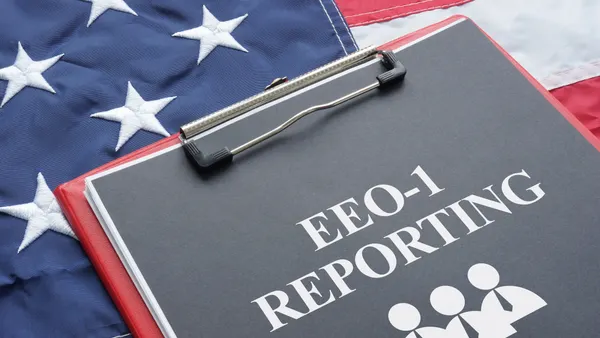
Employers may be entering a new era of employment law compliance — one not marked by the scramble to file EEO-1 reports.
But that doesn’t mean they’ll stop collecting workforce demographic data, sources told HR Dive. Employers have found that the process illuminates patterns, supports talent initiatives and more.
EEOC moves to undo mandates
The U.S. Equal Employment Opportunity Commission in July proposed a rule that would end EEO reporting, including the filing of EEO-1, EEO-2, EEO-3, EEO-4, EEO-5 and EEO-6 reports. EEO-1 is perhaps the most well known, as it requires demographic data collection from employers with 100 or more employees and certain federal contractors with 50 or more employees.
The agency has characterized demographic data collection as a burdensome task plaguing businesses, and claimed that EEO reporting encourages employers to discriminate against employees who aren’t “minorities” and to engage in racial stereotyping.
A public comment period on the proposal closed in late August, and EEOC has not yet indicated when it aims to publish a final rule. EEOC did not respond to multiple requests for comment.
Some reporting requirements remain
The submitted comments perhaps largely delivered what stakeholders would expect to see: A trial attorney advocacy group argued against the rescission, while a think tank founded by Trump advisors celebrated the move as a shift away from “discriminatory DEI practices.”
But for HR professionals and business leaders, it’s not that simple.
First, some legal requirements remain. “Like a lot of employment issues nowadays, it will now come down to compliance with a patchwork of state and local laws. If the EEO-1 requirement is removed, there are still several states that require similar reporting,” Mark Goldstein, a Reed Smith partner, told HR Dive. He highlighted requirements from California, Colorado, Illinois and Massachusetts, as well as New York City. For companies that operate in these municipalities and for multistate employers, much may remain the same.
Moreover, employers will likely opt to maintain some type of recordkeeping, according to Jennifer Robins, counsel at Saul Ewing. It could help in defending litigation or allow HR to see whether talent initiatives are working, sources said.
SHRM, in its comment to EEOC, implored the agency not to end the mandate without replacing it — or at least providing some guidance.
A new kind of headache
Employee advocacy organizations responding to the agency’s request for comments sounded the alarm about a vicious cycle, where a lack of legal frameworks could lead to the kind of workplace culture that engenders discrimination — thereby leaving employers more at risk of violating Title VIl of the Civil Rights Act.
The rescission also “would deprive employers, researchers, policymakers and advocates of their ability to independently analyze and use this unique data source to develop and advocate for policies that support the EEOC’s mission of ending workplace discrimination,” according to the Economic Policy Institute.
For example, “[l]arge and persistent disparities in employment and pay of Black workers relative to white workers are among the most durable features of the U.S. labor market,” the firm wrote. “Compelling empirical evidence points to discrimination as a significant factor in the persistence of those disparities.” And at EEOC, a historically under-resourced agency, “EEO data is essential to directing those limited resources,” EPI said.
And for HR professionals, removing this demographic data collection framework without offering up a replacement “could leave employers with significant questions,” according to SHRM’s comment, authored by Emily Dickens, the organization’s chief administrative officer.
SHRM was careful to acknowledge that it is “not arguing that the EEOC must retain those reporting requirements” but advocating for guidance on what exact demographic information employers should collect and maintain; when that information should be gathered and how long it should be kept; who has access to said information; and how it should be used. Without concrete federal guidance in this area, employers would be left to develop unsanctioned approaches to data collection, Dickens said.
The ‘burden’ may be worth it
Ultimately, if EEO-1 reporting is no longer mandated, demographic data collection moves from compliance exercise to leadership choice, Laurie Henneborn, vice president of research, insights and solutions at Catalyst, told HR Dive via email.
“When organizations stop measuring, problems don’t disappear. They simply become harder to see,” Henneborn said, citing patterns in hiring, compensation, promotion and other aspects of the talent cycle. “Without measurement, it’s harder to know whether talent systems are working as intended or whether barriers are emerging that affect performance, engagement, or retention.” she said. “The value of workforce data was never limited to compliance,” Henneborn said.
Employers may well decide the cost of that administrative burden does not necessarily outweigh the benefit, Goldstein said. The collection can be instructional for some organizations, he agreed, but the decision to continue collecting demographic information will need to be made on a case-by-case basis.
It’s also up to employers to handle this information delicately.
Employers should have always been careful about such data collection, but they should be even more so now, Robins said. HR should make clear that it’s voluntary for workers to provide demographic information, and that there will be a firewall between collecting this information and making personnel decisions.
“Employers should have always been careful that, for example, any disparate impact analysis that they’re doing, they are not then relying on the outcome of that analysis to make a different race-based decision. That will continue to be important in the sort of thing that EEOC has said that they are worried about.”
Goldstein echoed that advice. “If you’re asking for this information voluntarily, make sure that you’re doing it in a legally compliant way,” he said; make the information available only on a need-to-know basis and unusable for discriminatory treatment.
What an uncertain future may hold
Looking further ahead, some policymakers may attempt to fill in the gaps if EEOC finalizes a recission. “I would expect more state and local jurisdictions to consider and potentially adopt legislation requiring some sort of demographic reporting requirements,” Goldstein said.
But for now, HR workflows should remain largely unaltered, Robins said. “Employers shouldn’t make big changes right now. This rule is still in process,” she said. “It’s not yet been finalized, and even if it is, they may have other good reasons to continue with similar, if not the same, recordkeeping.”
HR professionals planning ahead also should keep in mind the empowering quality data can have, Henneborn advised. “The strongest organizations use data as a diagnostic tool. They look for patterns, ask questions, listen to employees, and make improvements where needed.”
“The organizations that emerge strongest in the years ahead will likely be those that stay focused on evidence-based decision-making,” she said, “regardless of changes in the regulatory landscape.”