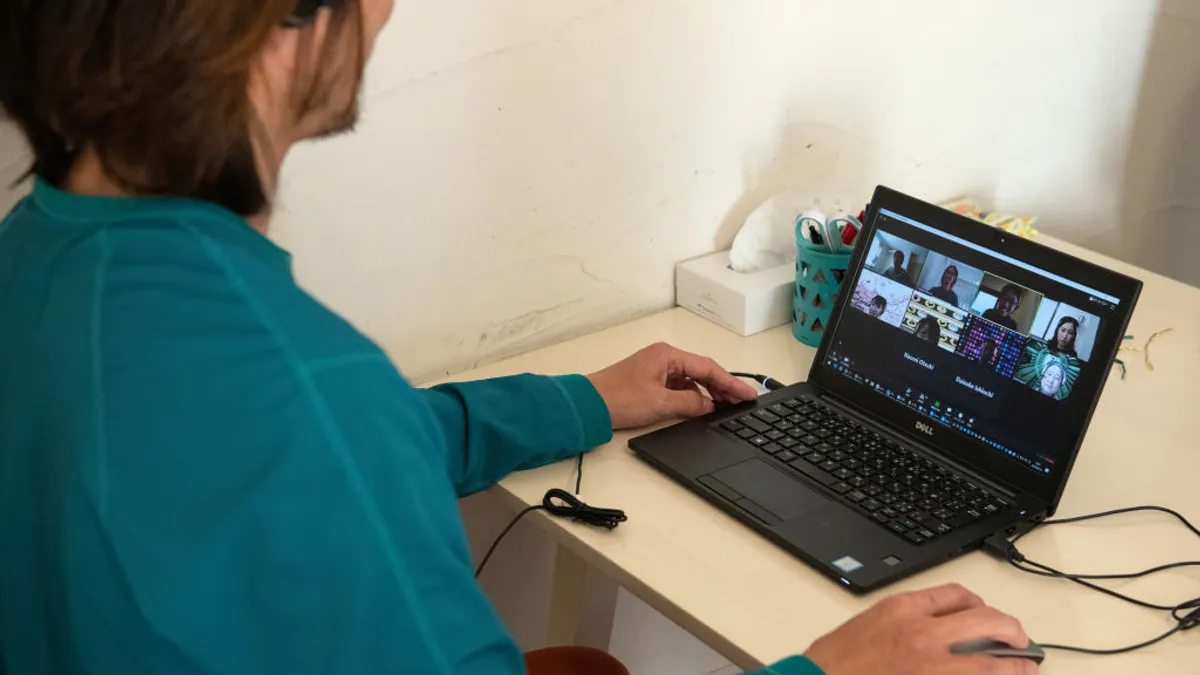
Sitting in the background of modern office meetings and job candidate interviews is an increasingly familiar presence: the electronic notetaker.
Artificial intelligence has powered a recording software boom as transcription services and similar tools aim to summarize hours of human-to-human discussion. But the use of these systems by HR teams has raised red flags among practitioners and legal counsel.
An emerging issue is that some platforms may not even alert participants that a recording is in progress or that it will be transcribed or used for future purposes, said Brian McGinnis, partner at Barnes & Thornburg. This is meant to reduce friction and is even marketed as an attractive feature, but it could be a legally dubious one depending on where participants are located.
Various states require all-party consent to recording of conversations, such as California, Florida and Illinois. And given that modern virtual calls can involve participants from any state or country, HR teams will need to take note and manually obtain others’ consent if the notetaker or recording tool doesn’t automatically provide an opt-out.
There’s also the matter of context. McGinnis said he is seeing HR teams most often use automated notetakers in the recruiting space, which is potentially problematic given an emergent trend of state and local laws regulating the use of AI in employment decisions. For this reason, a video call with a potential hire that features AI-based recording and transcription is “considered more high risk than your typical Zoom meeting,” McGinnis added.
Separately, a handful of states have workplace monitoring laws that may come into play, said Adam Solomon, partner at Hunton Andrews Kurth, and these laws often specify how employers must provide advance notice to employees about recording technologies. And there are even more categories of laws that could be applicable, Solomon noted, including social media privacy laws and intrusion on seclusion torts, which not all states recognize.
“That’s the hodgepodge we tend to think about,” Solomon said. “While there’s a lot of different restrictions, the bottom line is that reading these laws rather permissibly basically creates an opt-out regime.”
AI notetakers present a governance issue in much the same way as any workplace tool, said SHRM CHRO Jim Link, so it’s incumbent upon HR teams to know the ins and outs of their notetakers before deploying them. Recordings also may capture protected or sensitive information, creating even further compliance exposure.
“By golly, I would want to have all of my ducks in a row if I was using this in this current landscape,” Link said.
Is full disclosure the simple answer?
As a baseline matter, SHRM encourages HR teams to disclose the use of AI tools, Link said. If any sort of recording or transcription is in progress, employers should seek the okay of all present parties before proceeding.
“Transparency is absolutely part of the employee experience,” he continued. “The more transparent and descriptive they are of the technologies and tools they’re using and the knowledge and data that is used or gained, the better.”
Link also noted the importance of ensuring that human beings make HR decisions rather than AI or any other tool. AI can help HR teams make good decisions, but the final call should ultimately lie with a human decision-maker, he said.
From a compliance standpoint, employers may want to adopt a strategy of identifying the jurisdiction with the most stringent requirements for notetaking or recording tools and applying that standard broadly. This is an operationally easy approach, McGinnis said, but it also means that organizations will need to pay attention to new laws over time and adapt accordingly.
A trickier question concerns how recorded conversations are used once they are saved in an AI tool developer’s system.
While vendors generally follow principles such as deidentification, anonymization and aggregation in order to create less identifiable and sensitive datasets to train their models, each provider has its own specific process for doing so, McGinnis said. This is generally laid out in a tool’s service terms, and legal counsel may be able to assist employers in understanding what steps a vendor takes to comply with relevant privacy and data laws.
HR’s emerging role as a vetter of tech
Technology has always been one of many functions beneath HR’s very wide umbrella, but it is fast becoming a bigger priority in the age of AI.
Link said he receives at least two to three unsolicited messages per week from a person or vendor pitching a new AI capability or tool, many suggesting that their tools allow employers to make informed decisions to increase the likelihood of a successful hire. But even if AI is helpful, HR must ensure it vets specific tools thoroughly before deciding how to use them, if at all, he added.
“At the end of the day, if an employer can’t explain where candidate data comes from, how it’s protected and what becomes of that knowledge or information, then that tool is not ready for hiring use,” Link said. “Our preference is that employers own that data and control how it is used.”