Federal agencies including the U.S. Department of Labor, Equal Employment Opportunity Commission and Department of Homeland Security provided a series of updates on new and existing regulatory efforts to the White House Office of Management and Budget on Friday.
The filings provided timelines on forthcoming proposed and final rules such as worker classification while announcing new regulations addressing work hours for minors, protections for pregnant workers and disparate impact liability theory, among other subjects.
The announcements are part of the Trump administration’s broader push to reshape federal employment law compliance, particularly in the antidiscrimination and wage-and-hour contexts.
DOL targets October for independent contractor rule
One of the biggest items given more clarity last week is the Trump administration’s independent contactor rule, the proposed version of which DOL published in February.
The proposal would return the agency’s interpretation of the Fair Labor Standards Act closer to that of the version adopted during Trump’s first term in office. The rule would be centered on an “economic reality test” that examines a worker’s main source of income via two core factors: the degree of control the worker has over their work, and their opportunity for profit or loss based on initiative, investment or both.
DOL set an October 2026 deadline for the independent contractor final rule. It estimated that the rule would provide an “initial, one-time regulatory familiarization cost” of $488 million to be offset by a cost savings of nearly $683 million achieved through “increased clarity.”
Separately, the agency confirmed it is continuing its work on a proposed rule interpreting joint employment standards under the FLSA. DOL announced a proposal in April but has yet to provide a timeline for a final rule.
DOL also announced new wage-and-hour regulatory efforts, with one proposal aimed at addressing tip credits against the FLSA’s minimum wage requirements. Given an August timeline by DOL, the proposal would follow up on an area that has been addressed by successive administrations.
One of the most recent such efforts had been undertaken by the Biden administration, which sought to clarify when employers may take a tip credit against the FLSA’s minimum wage requirements for employees who perform both tipped and nontipped work, also known as a “dual job.” A federal judge struck down the proposal, and it was later discarded.
Another proposal follows a series of moves by state and local governments to ease labor shortages by allowing younger workers to take on more work hours. DOL targeted September for a rule to amend its regulatory standards under the FLSA relating to permissible work hours for 14- and 15-year-olds.
EEOC to revisit old guidance documents in enforcement shift
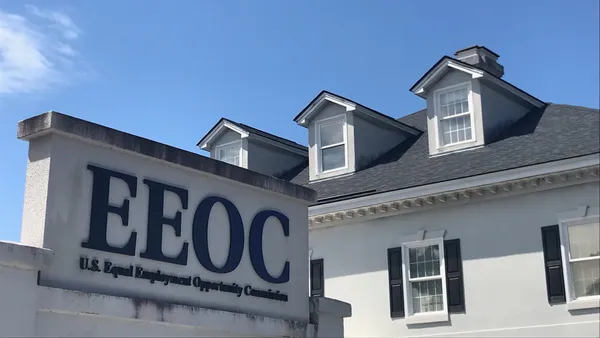
The nation’s federal workplace civil rights law enforcement agency made headlines in recent weeks when it submitted a plan to the White House to end its annual demographic data reporting requirement programs, like the EEO-1. Last week, the agency clarified that it would release a notice of proposed rulemaking this month with a public comment period on the proposal to end in September.
“This EEO data collection was not mandated by statute, but was an agency-created requirement, which imposed a significant financial and administrative burden on America’s employers, including thousands of small businesses,” the agency said in a statement attached to the OMB notice.
Attorneys who previously spoke to HR Dive generally advised HR departments to retain their EEO-1 reporting processes in spite of the news, both to prepare for any resumption of the program and to comply with applicable state data collections.
EEOC also announced the proposed rescission of several decades-old interpretive rules. One of the documents addressed disparate impact liability in the context of national origin discrimination, which follows the Trump administration’s broader efforts to end regulators’ reliance on disparate impact generally. A similar action would rescind a 1979 interpretive rule on affirmative action programs.
The commission also seeks to rescind a 1979 appendix to its guidelines on sex-based discrimination, which EEOC said had been written shortly after passage of the Pregnancy Discrimination Act. The agency said the appendix is “outdated” and predates the 2022 enactment of Pregnant Workers Fairness Act.
In a LinkedIn post Monday, Kalpana Kotagal, the EEOC’s lone Democratic commissioner, said that she voted against the agency’s regulatory changes. Specifically, Kotagal said the potential rollback of EEO-1 reporting could “kneecap its ability to investigate discrimination,” while the other proposed updates would weaken workers’ civil rights protections.
“I fear that the rescissions will leave a void that will sow uncertainty for employers and ultimately undermine equal employment opportunity,” Kotagal wrote. “This is an unforced error; we should be standing up for workers, not weakening their civil rights.”
Coming soon: Yet another update to the H-1B visa program
Employers have already had to adjust to an overhaul of the H-1B visa program for skilled foreign workers. Within the past year, the Trump administration issued changes to prevailing wage rates for visa holders, implemented wage-based selection criteria for visa petitions and announced a $100,000 fee on new H-1B visas — the latter having been subject to several legal challenges.
Last week’s regulatory agenda showed DHS is pursuing even more updates. The agency said it would propose a new rule in August seeking further H-1B program reform, including revisions of cap exemption eligibility, greater scrutiny for employers that have violated the program’s requirements and increased oversight over third-party placements.
“These changes are intended to improve the integrity of the H-1B nonimmigrant program and better protect U.S. workers’ wages and working conditions,” DHS said.