Dive Brief:
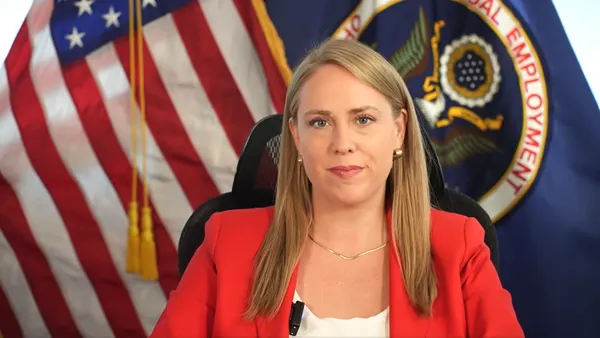
- Former U.S. Equal Employment Opportunity Commission vice chair Jocelyn Samuels voluntarily dismissed her lawsuit against President Donald Trump, a court document filed Monday revealed.
- The action followed last week’s U.S. Supreme Court decision in Trump v. Slaughter, which overturned the 91-year-old precedent of Humphrey’s Executor and held that the president has the authority to remove independent agency leaders without cause.
- In a statement released by her legal team, Samuels said her decision to drop the lawsuit was prompted by the high court’s opinion, which left her “without a viable path forward.”
Dive Insight:
In her April 2025 lawsuit, Samuels argued that her firing “undermined the EEOC’s historic independence and interfered with its statutorily mandated duties to protect workers from discrimination” and that Congress did not grant the president authority to remove EEOC commissioners at will.
“Because the Commissioners perform predominantly quasi-judicial and quasi-legislative functions, these restrictions on the president’s removal authority are constitutional,” attorneys argued in Samuels’ complaint, referencing Humphrey’s Executor v. U.S., a Supreme Court opinion from 1935.
Experts have long anticipated the challenge to Humphrey’s Executor and its potential overturning under a conservative-majority court. In January 2025, a Seyfarth Shaw partner wrote the firings of Samuels, Charlotte Burrows and other agency officials appeared to be part of a strategy to establish expansive presidential removal authority over bipartisan independent agencies.
While Chief Justice John Roberts wrote for the majority that Congress may not deprive the president of his executive power by foisting independent agencies upon him, Justice Sonia Sotomayor, in her dissent, warned the decision “discards that democratic regime in favor of one that distorts the structure of Government to fit the majority’s theory of unitary, total executive control.”
“The result is a President who emerges with far greater power than ever before,” she continued.
Samuels also pointed to Trump-aligned changes at EEOC that make the Slaughter decision particularly “damaging for workers.” She cited the abandonment of LGBTQI+ employees, declined or delayed processing of complaints “clearly covered by the anti-discrimination laws,” fishing expeditions that conflict with procedural constraints and rescinded guidance that employers rely on but that “conflict with this Administration’s ideological agenda.”