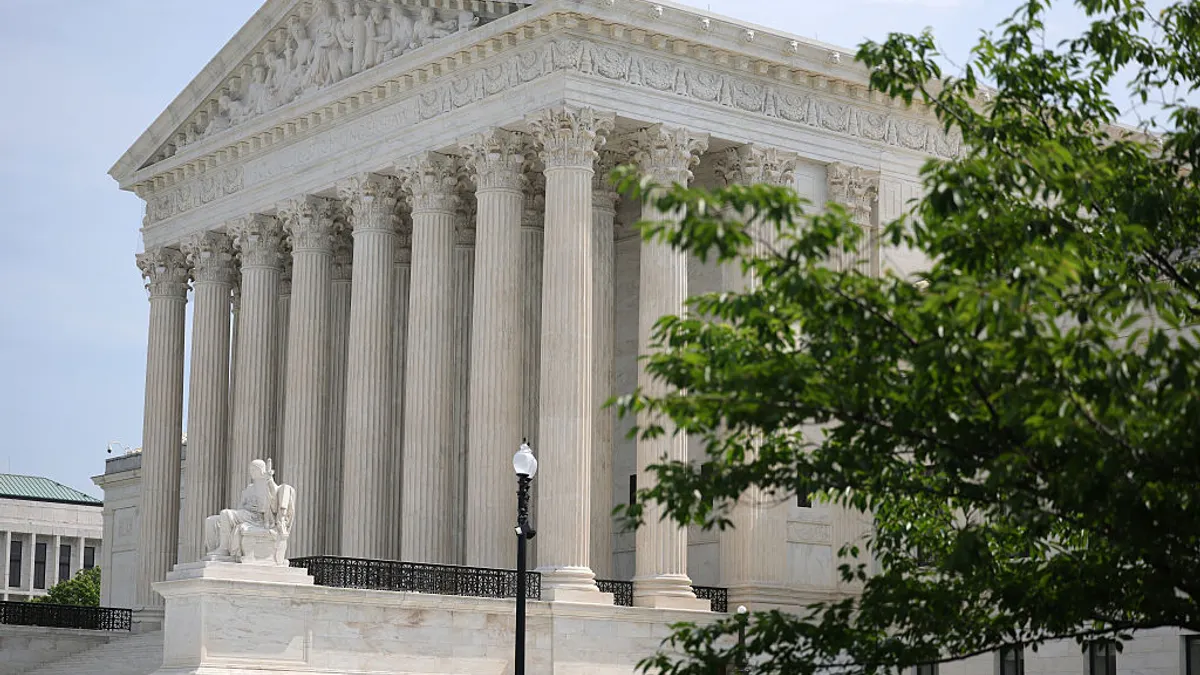
A more than 90-year-old U.S. Supreme Court decision that shielded heads of certain independent federal agencies from at-will removal by the president violated the Constitution, the court held in a landmark 6-3 ruling Monday.
Chief Justice John Roberts wrote for the majority in Trump v. Slaughter that the high court’s 1935 decision in Humphrey’s Executor v. U.S. was “tethered to a highly circumscribed and almost fictional view” of the Federal Trade Commission. He said the 1930s court wrongly held that, because the FTC exercised neither political nor executive power, its commissioners could be removed only for “inefficiency, neglect of duty, or malfeasance in office.”
This longstanding precedent faced scrutiny in the years since, Roberts continued, and disagreement over the implications of Humphrey’s Executor culminated in 2025, when President Donald Trump attempted to fire agency leaders including Rebecca Slaughter, a Democratic FTC commissioner. Trump gave no cause for Slaughter’s firing other than that her continued service was inconsistent with his administration’s priorities.
Slaughter challenged her removal as unconstitutional, but the Supreme Court held that she and other officials who exercise executive power on behalf of the president may be dismissed with no restrictions. This is the case even if such agencies are designated by Congress as “independent” agencies, the court said.
“If Congress wishes to establish independent agencies to assist it with its functions, it may do so,” Roberts wrote. “But it may not foist those agencies upon the President, and thus deprive him of ‘the executive power vested [in him] by the Constitution’ — something Humphrey’s itself never purported to permit.”
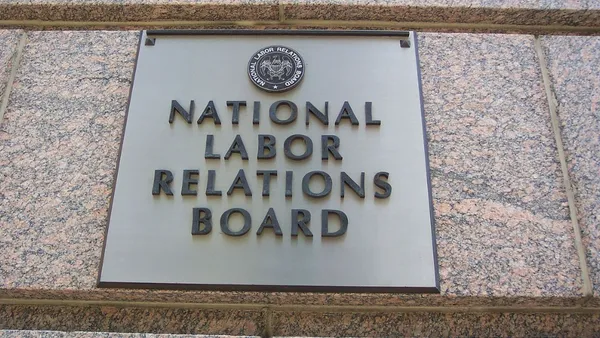
The ruling may be relevant as former Democratic leaders of federal workplace enforcement agencies challenge their removals. Trump similarly dismissed officials of the U.S. Equal Employment Opportunity Commission and the National Labor Relations Board. The high court previously denied a petition for certiorari before judgment filed by former NLRB member Gwynne Wilcox, who challenged her removal by Trump. A separate lawsuit filed by former EEOC Commissioner Jocelyn Samuels had been stayed pending the outcome of Slaughter.
The court’s decision will likely affect multimember agencies like NLRB even if the decision’s full reach is presently unclear, Timothy Taylor, a former deputy solicitor of labor at the U.S. Department of Labor and partner at Holland & Knight, said in an email. Other agencies, like EEOC, also may be affected, Brian Hayes, co-chair of Ogletree Deakins’ traditional labor relations practice group, said in an email.
Should the ruling result in agencies becoming more responsive to a presidential administration’s priorities, agency policy may shift more rapidly between administrations and create uncertainty for employers, Hayes added. He said employers may want to monitor developments in Wilcox’s lawsuit as well as that of Cathy Harris, a former member of the Merit Systems Protection Board.
“If the challenges fail, as now appears likely, the administration’s actions will stand — potentially reshaping these agencies’ direction and priorities for the foreseeable future,” Hayes said.
In Slaughter, Roberts sidestepped application of the decision to officials besides the FTC official, noting that tenure protections for judges of non-Article III courts, for instance, were not before the court in this case.
He instead referred back to the court’s 1926 decision in Myers v. U.S., which described the power of the president to appoint and remove executive officers. Under Myers, Roberts said that officials who handle a function that is traditionally outside of the executive branch may not be subject to at-will removal.
One such example is the Federal Reserve, Roberts said. The court simultaneously issued a decision Monday in Trump v. Cook, in which it held that Trump’s removal powers were restricted with respect to the Fed’s board of governors, due in part to a “long tradition” of monetary policy exercised independently of executive influence.
Justice Sonia Sotomayor dissented from the Slaughter opinion, joined by Justices Elena Kagan and Ketanji Brown Jackson. Sotomayor said that the majority’s decision gives the president “power unknown even to the English Crown” and could transform agencies in ways not intended by Congress.