The U.S. Equal Employment Opportunity Commission sent a final rule rescinding guidance related to conviction and arrest records in employment decisions to the White House on Tuesday.
The rule would rescind guidance from 2012 that outlined best practices for employers screening job applicants with any kind of criminal history. At the time, EEOC said the guidance was crucial because a criminal record doesn’t constitute a protected class, but how a recruiter makes decisions based on a criminal record could lead to disparate treatment of — or a disparate impact on — a job candidate.
This new proposed measure from EEOC is a natural progression from President Donald Trump’s executive order last year that directed the attorney general and EEOC chair to re-assess all investigations, lawsuits and positions related to disparate impact and act in accordance with the White House’s stance that disparate-impact liability theory is part of “a pernicious movement.”
The framework EEOC is leaving behind
The 2012 rule, “Enforcement Guidance on the Consideration of Arrest and Conviction Records in Employment Decisions under Title VII of the Civil Rights Act,” thoroughly laid out parameters for employers who need to address criminal histories of workers. The guidance highlighted three key tenets for HR to consider: The nature and gravity of the offense or conduct, the amount of time that has passed since the offense or conduct and/or completion of the sentence, and the nature of the job held or sought.
EEOC also reminded employers that “an arrest does not establish that criminal conduct has occurred” and that even in the face of a criminal charge, an individual is “presumed innocent unless proven guilty.” The 2012 guidance features hypothetical scenarios to help business leaders understand the nuances of this.
Further, the agency asked decision-makers to consider the number of offenses with the conviction, length and consistency of employment history before and after the offense, evidence that the individual performed the same type of work post-conviction with no known incidents of criminal conduct, and rehabilitation efforts, among many other factors.
A death knell for disparate impact
At the time, EEOC said it was up to employers to determine whether denying employment based on a criminal record counts as discrimination on race, color, religion, sex, or national origin.
Under the 2012 guidance, disparate treatment comes into play when an employer engages in behavior that indicates racial or national origin bias is a factor in their decision-making. This includes behaviors such as making derogatory statements about an individual’s protected group, such as expressing “group-related stereotypes about criminality.” This also includes inconsistencies in hiring, where people of different races with criminal records are treated differently.
In the document, the agency noted that due to disproportionate representation of certain groups among those arrested and incarcerated, criminal record exclusions could also support a finding of disparate impact.
Fast forward to last April, when Trump signed an executive order that thoroughly condemned the use of disparate-impact liability. Highlighting the importance of “meritocracy and a colorblind society” as key principles of the “American Dream,” the executive order asserted that considering disparate impact places a “potentially crippling” legal burden on employers.
“It not only undermines our national values, but also runs contrary to equal protection under the law and, therefore, violates our Constitution,” Trump said.
Shortly after, an administrative judge at EEOC told HR Dive that Trump’s directive was “highly illegal.”
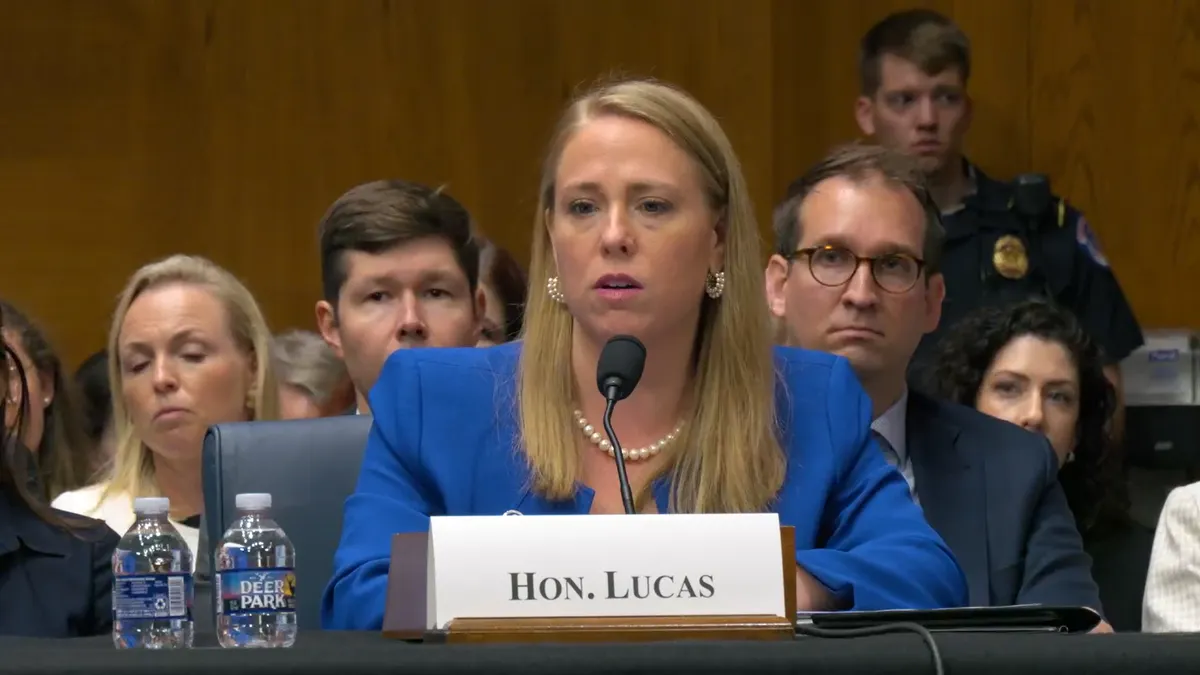
Other agencies and some judges have backed the order, however; earlier this year, prompted by EEOC Chair Andrea Lucas, the U.S. Department of Justice said EEOC’s disparate-impact guidelines, as developed prior to Trump’s order, are unconstitutional. The U.S. Department of Labor issued a final rule to eliminate disparate-impact liability from its antidiscrimination regulations in July. And a federal judge dismissed a lawsuit challenging EEOC’s nonenforcement of disparate impact liability in 2025.
What this means for HR
HR Dive reached out to EEOC for comment on how this will affect HR professionals but did not hear back by press time. However, attorneys at Littler had some insights on how HR professionals should proceed should EEOC’s new guidance be finalized.
Employers should not automatically decide now to use arrest or conviction records “however they wish without fear of liability,” wrote Jim Paretti, co-chair of Littler’s Workplace Policy Institute, and Barry Hartstein, co-chair of Littler’s EEO & Inclusion Practice Group, in a blog post.
Most importantly, employers that apply a “criminal background policy more harshly against one protected class than another … will still likely violate Title VII,” and EEOC may still investigate that employer’s conduct anyway, the attorneys wrote. They acknowledged EEOC’s step back from disparate-impact liability cases but also noted “the theory is still recognized by the U.S. Supreme Court and was codified by Congress in Title VII.”
“As such, disparate impact claims may still be brought under federal law — that the EEOC has stated it will not bring such cases does not mean that the plaintiff’s bar is limited in doing so or will follow suit,” they added.
Timelines for when the White House’s Office of Management and Budget will finish reviewing EEOC’s final rule — or how quickly EEOC will rescind the 2012 guidance — remain unclear.