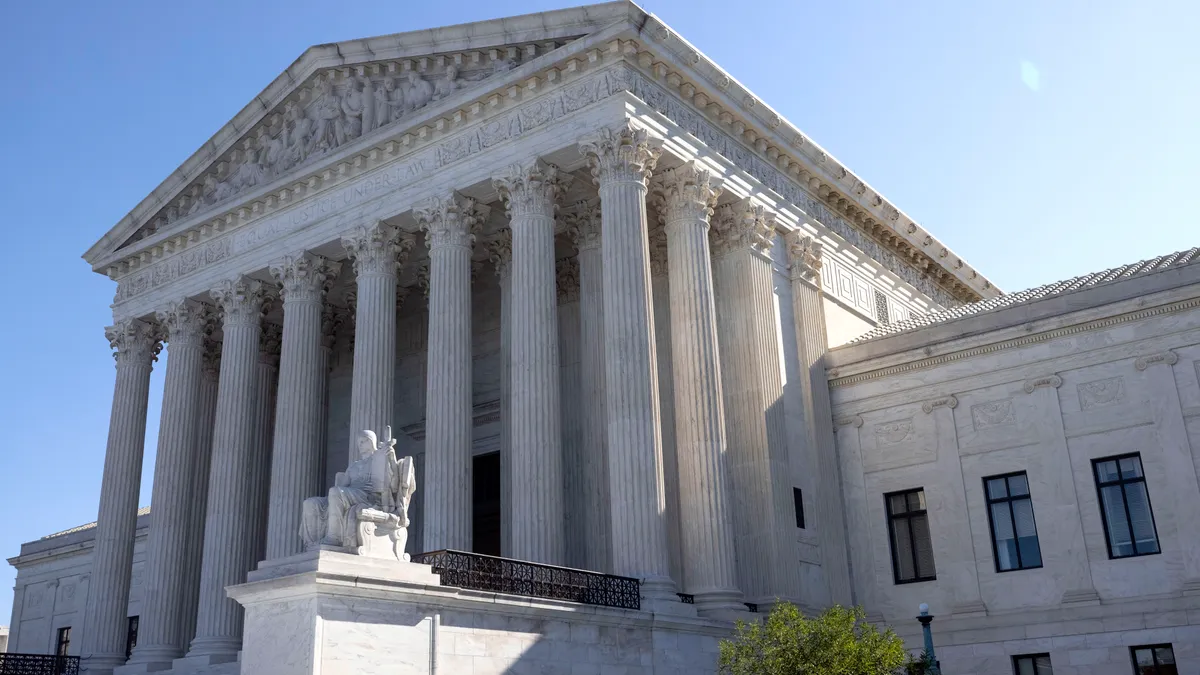
The U.S. Supreme Court declined to hear several employment law cases in recent weeks as its 2026-2027 term takes shape, with several petitions rejected on Tuesday alone.
Two of the claims at issue concerned allegations of disability discrimination. In one case, Greer v. Benton School District, petitioners asked the court to decide whether Section 504 of the Rehabilitation Act, which prohibits discrimination in federally funded programs, enables independent contractors to sue.
The Supreme Court of Arkansas held that Section 504 did not cover such plaintiffs, and it dismissed the lawsuit of a substitute teacher who had previously won a jury verdict against a state school district.
Similarly, the court dismissed a petition from a former air marshal who challenged her reassignment by the U.S. Department of Homeland Security. The case, Redding v. Mullin, asked the justices to evaluate the legality of the reassignment — which followed the plaintiff’s request to take disability retirement — and whether the appeals court properly evaluated her failure-to-accommodate claims.
The justices previously punted on a few cases involving other discrimination allegations. In May, the court declined to opine on whether a judge or jury should decide that intentional discrimination against a White person pursuant to a corporate diversity, equity and inclusion policy satisfied the “but for” causation standard under Title VII of the 1964 Civil Rights Act.
The petitioner in Armstrong v. Warner Bros. alleged that the entertainment company refused to hire him because of his race, citing the company’s DEI commitments as evidence of bias. The 9th U.S. Circuit Court of Appeals held in favor of Warner Bros.
In June, the high court declined to take up Lowery v. Mills, in which a University of Texas professor alleged that he was disciplined in retaliation for speaking out against DEI policies. The petitioner asked the court to decide whether his employer’s threats to his pay, institutional affiliation and access to research opportunities were sufficient to establish a First Amendment retaliation claim.
Court punts on COVID-19 workplace mandates
Claims related to COVID-19 vaccination and testing mandates have worked their way through federal appeals courts over the past year, but the Supreme Court declined multiple opportunities to weigh in on the subject.
In Colson v. Hennepin County, Minn., petitioners asked the high court to decide whether an employer’s threat of discipline for failing to comply with a weekly COVID-19 testing requirement, and forcing her to choose between following her religious beliefs or losing her job, is an adverse employment action under Title VII. The 8th Circuit dismissed the case in a 2-1 decision.
Similarly, the justices denied a petition in Troogstad v. City of Chicago, Ill., in which a group of employees asked the court to opine on whether Chicago’s city government violated their substantive due process rights by requiring them to be vaccinated against COVID-19 as a condition of their employment.
On the same day as the denials in Colson and Troogstad, the court denied certiorari in Petersen v. Snohomish Regional Fire and Rescue. The 9th Circuit had held in the case that a Washington state firefighting department did not discriminate against a group of firefighters who requested religious exemption from its COVID-19 vaccine mandate. The employer claimed that it could not accommodate the plaintiffs without imposing undue hardship on its operations.
Bevy of labor law disputes rejected
The court refused to wade into a dispute arising from New Jersey, in which an employer petitioner asked it to decide whether an unauthorized immigrant worker who intentionally used a false Social Security number to obtain employment was eligible to recover pay for work performed under the Immigration Reform and Control Act of 1986. The New Jersey Supreme Court held that the employee could be so eligible.
SCOTUS also denied certiorari in a case brought by the former owners of the Pittsburgh Post-Gazette. The petition questioned whether the National Labor Relations Act permits a finding of the National Labor Relations Board that an employer has bargained in bad faith solely on the substance of its proposals on mandatory subjects of collective bargaining, without evidence of bad-faith behavior away from the bargaining table.
The same petition asked whether the 3rd Circuit’s “highly deferential” review of the NLRB’s interpretation of its statutory authority conflicted with the high court’s holding in Loper Bright Enterprises v. Raimondo, a landmark decision in which it clarified that federal courts need not defer to agency interpretations of laws simply because a statute is ambiguous.
Another denied case that challenged the Board, Garten Trucking LC v. NLRB, also cited Loper Bright. Petitioners asked the justices to decide whether the 4th Circuit showed excessive deference to NLRB where the agency reversed the decision of one of its administrative law judges to find that an employer must bargain with its employees.