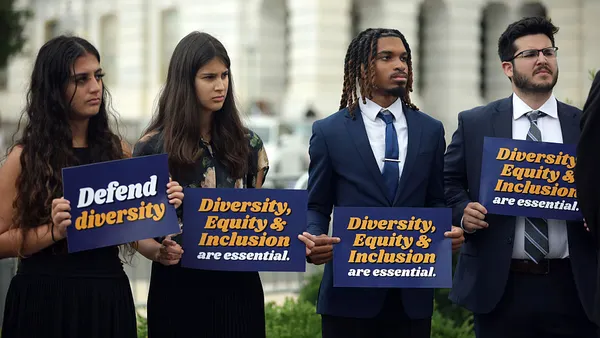
After several years of sociocultural backlash to diversity, equity and inclusion programming at work, the attitude toward DEI seems to be definitively shifting, according to recent Gallup data.
Up from 61% last year, 71% of Americans polled by Gallup and Bentley University in May said it is “somewhat” or “completely” true that companies with diverse workforces are more profitable, according to a September report. The percentage of people saying that more diverse workplaces make for more innovative products also increased.
Republicans’ and Democrats’ positive attitudes about DEI also increased — something that Gallup teased out as noteworthy.
As one would expect given President Donald Trump’s clear stance toward DEI and the Heritage Foundation’s take on DEI, both which have set the tone for the party, Republicans are less excited about DEI than Democrats or Independents. Still, the percentage of Republicans who see DEI as a boon to business profitability is up 11% year over year.
While the bullishness toward DEI under Trump’s administration is surprising given the climate, the DEI backslide appeared to start as early as 2021 — when not all companies that had made pie-in-the-sky-promises in 2020 had followed through on them. The enthusiasm was waning in 2022 and by 2023, workplace experts were telling HR Dive how people professionals could recalibrate their employee offerings.
DEI discussions and adjustments began long before Trump returned to the Oval Office, where executive orders and mass DEI rollbacks accelerated a chilling effect on inclusion efforts in the workplace.
Amid a challenging political, legal and cultural landscape, how should HR — and business leaders in general — make sense of these recently reported findings?
“The survey data continue to show support for many of the underlying goals associated with DEI, while the broader social and legal environment surrounding DEI has changed considerably,” Emily Corwin, a Bentley University assistant professor of management, said in a statement to HR Dive.
Still, Corwin, who researches HR, inclusion and organizational psychology, added that due to this challenging climate, employers “have to think carefully about how they communicate and implement these efforts while balancing legal compliance, organizational priorities, and the expectations of employees and other external stakeholders.”