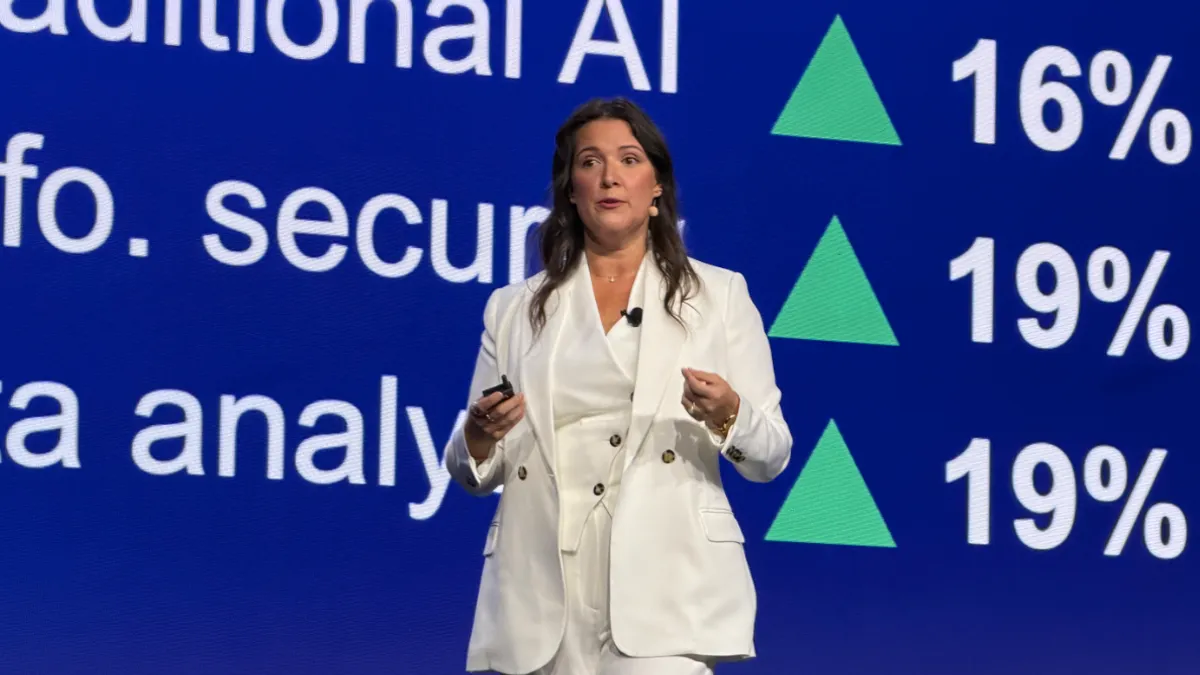
Talent acquisition leaders don’t need to be told twice that change is the norm these days — especially since TA teams tend to be leading HR in artificial intelligence tool deployment, Jamie Kohn, senior director analyst in the Gartner HR practice, said during a Monday session at the Gartner HR Symposium/Xpo.
But recruiters and hiring teams are also beset by complicated, contrasting demands from employers and candidates alike. AI, risk management, hiring for skills — “your talent strategy will be shaped by the collision of these forces,” Kohn said.
During the session, Kohn shared four trends that are defining the TA experience right now and what organizations can do to lead the way amid these transformations.
1. Machines are a new talent brand audience
Generative AI is more integrated into daily lives, meaning more people are relying on the tech to make decisions, including employment ones.
“Machines increasingly determine whether candidates hear about us at all,” Kohn said.
By 2029, 1 in 4 candidates may be represented by a machine, per Gartner research — an agent that acts for the candidate, rather than a machine that the candidate uses.
“You may be getting applications from people who have never heard of your job or company,” Kohn said — and AI makes those decisions for candidates based on information companies “do not fully control.”
Generative AI doesn’t stop at the career website. It pulls from news coverage, Reddit and employee reviews on 3rd party websites, among other places, to decide whether to share a job opening with a candidate, Kohn said.
To ensure AI agents pass along job openings to the candidates companies want to reach, employers need to create clear, structured, text-based content — videos with readable transcripts, for example. Content also needs to be up to date with the latest cultural reflection of the company, such as how it approaches flexibility.
Be specific, Kohn said. Support claims with data and employee stories, and don’t be afraid to be comprehensive in answering questions candidates may have — a shift from older demands for job information to be concise, she noted.
2. Companies shift from risk avoidance to risk awareness
Previously, employers generally sought to avoid AI risk around candidate assessment, Kohn said. But now, companies are more willing to use AI to scale work and thus are more accepting of risk, partly because to do otherwise is to potentially hamstring a team.
Application volume has more than doubled in the last two years, Kohn said; data from other companies points to volume near tripling, due in part to bots and AI agents. On top of that, organizations say they are working harder to find high-quality candidates.
In response to these pressures, the “firewall” around candidate screening and assessment is crumbling, Kohn said. Employers have an interest to get ahead of this — because recruiters are going to use AI “whether we approve it or not,” Kohn said.
Despite ongoing and constant regulatory shifts regarding AI use in candidate assessment, “the idea we are going to forever keep AI out of screening and assessment, it’s just not sustainable,” Kohn said.
To better assess the risk and reward of AI use in this way, consider where hiring is consistently high volume and critical for business growth — but also consider when AI “cannot reliably, validly or fairly evaluate candidate qualifications,” Kohn said. When skills are difficult to observe or success is ambiguous, risk increases regarding AI use.
Roles that “are stable and repeatable, where criteria are really clear and you can get a lot of scale” may be lower-risk areas in which to accelerate AI use, such as through implementation of AI interviews for candidates, Kohn said.
3. Technology ownership is changing
Rather than have to push a vendor through procurement to find budget or beg IT to make a new solution, Kohn said, recruiters have access to new features from current vendors as well as enterprise AI tools — and increasingly, recruiters are interested in building their own solutions, she noted.
“Every year brings new tech capabilities that are accessible almost instantly,” she said. HR tech leaders reported they were building AI agents directly in their human capital management platform, many of them leveraging no-code and low-code tools.
But this can create governance issues, like multiple tools being crafted that do the same thing, growing inconsistencies in process and technical debt, Kohn noted; “The challenge is not a lack of innovation. It’s keeping up with it.”
Analyzing this question requires employers to examine the balance of reach of the tool — whether it will be used by a single person or team versus the entire organization — and the risk of that use.
Recruiters, for example, could easily be supported to craft their own solutions for labor market analysis, Kohn said. Employers may want more oversight on solutions around candidate matching and rediscovery, however, even if those processes live only in TA. Assessments are an example of tools that ought to be enterprise-managed solutions due to the breadth of risk and use, per the presentation.
4. Recruiters need new performance metrics
Recruiters are struggling with both ongoing talent shortages and talent attraction, Kohn said.
All the while, recruiters — expected to build hiring pipelines and shape decisions — are pushed to act quickly, defer to hiring managers and focus only on open roles. “We’re asking recruiters to behave strategically while surrounding them with a system that enables and rewards the wrong behavior,” Kohn said.
To fix that, employers need to reexamine process design, data access and partnerships. And then employers need to adopt performance metrics that measure what they actually want recruiters to do, such as slate quality, time to productivity and candidate confidence, Kohn explained.
“If recruiters have to fight the system to be strategic, the system’s probably going to win,” she said.