A transgender former employee of the U.S. Equal Employment Opportunity Commission may proceed with his lawsuit alleging that EEOC discriminated against him and subjected him to a hostile work environment, a California federal magistrate judge held Friday.
The plaintiff, who worked for the agency as its director of information governance and strategy, resigned in June 2025 following a series of decisions made under the leadership of current Chair Andrea Lucas. Lucas had been appointed to acting chair by President Donald Trump months earlier and acted swiftly to shift EEOC’s stance on transgender discrimination.
Under Lucas, EEOC “engaged in a series of actions targeting transgender Agency employees,” according to the April 23 complaint. The plaintiff referenced policy shifts such as the commission’s changes to intake processes for certain discrimination charges, removal of references to LGBTQ+ employees in EEOC outreach and training materials and removal of the nonbinary categorization option in EEO reporting forms.
But Lucas also oversaw the disbanding of the commission’s internal LGBTQ+ employee resource group, the plaintiff claimed, and the agency revoked internal policies on nondiscrimination and inclusion with respect to gender identity that had been in place since 2009.
The cumulative effect of these shifts and others — including Lucas’s January 2025 press release announcing that the agency would roll back the “gender identity agenda” of the Biden administration in favor of “defending the biological and binary reality of sex and related rights” — made the plaintiff “feel that his existence and identity had been invalidated,” per the complaint.
EEOC moved to dismiss or strike the allegations, but Judge Thomas Hixon of the U.S. District Court for the Northern District of California sided with the plaintiff. Hixon held that the former director had standing to bring the claims and plausibly alleged that he was subjected to sex-based harassment as well as a hostile work environment.
An EEOC spokesperson referred HR Dive to the U.S. Department of Justice for comment. DOJ did not respond to a request for comment by press time.
Per the court, EEOC had argued that the plaintiff’s allegations consisted of “unactionable generalized grievances" stemming from the application of policy decisions. The agency also cited two decisions that supported the legality of its enforcement shifts with respect to gender identity discrimination and disparate impact discrimination, after advocates challenged the agency’s authority on those fronts.
Hixon disagreed, however, writing that the plaintiff did not challenge EEOC’s statutory authority to make such changes but instead claimed that the changes created a hostile work environment, ultimately leading to his constructive discharge.
“Plaintiff’s alleged injuries are no different from those in any other hostile work environment Claim,” Hixon said. “Those injuries are not shared in substantially equal measure by the agency’s workforce. That some of them arose from conduct of general application does not make them general.”
Moreover, the plaintiff alleged conduct beyond mere disagreement with the agency’s policy stances, the judge continued. For example, he claimed that his scope of responsibility and influence were reduced and that he was required to expedite the removal of all mentions of sexual orientation and gender identity from EEOC materials.
Such allegations plausibly described a “pervasive sex-based hostility that altered Plaintiff’s working environment,” Hixon said.
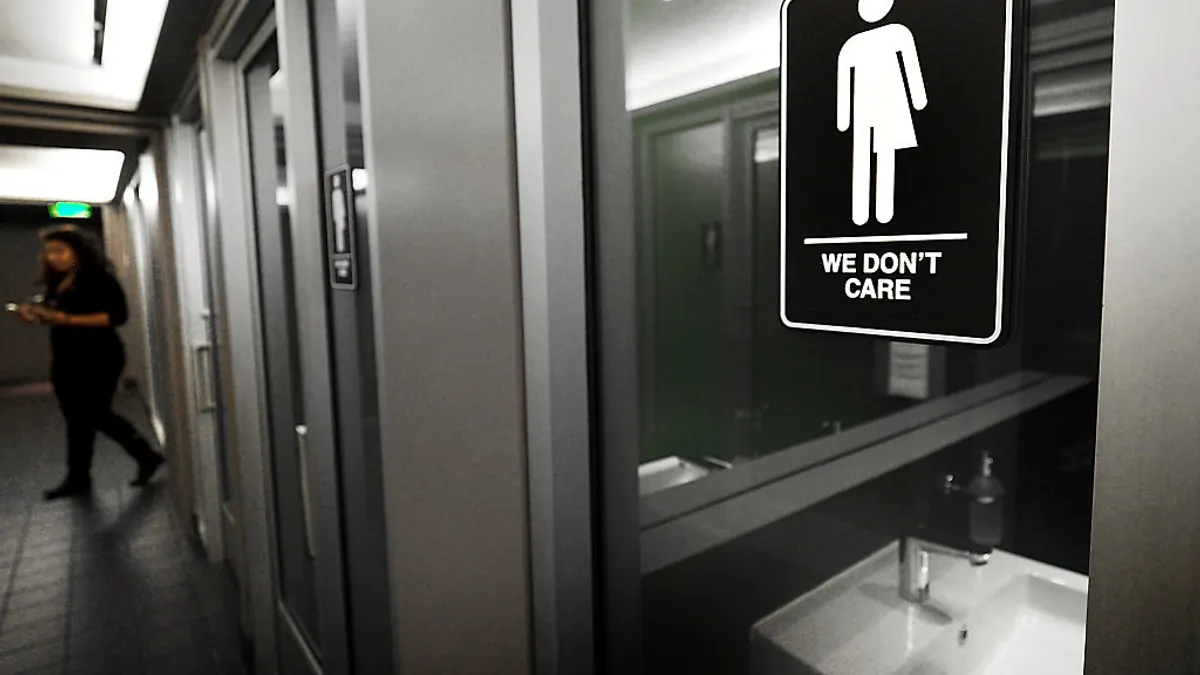
EEOC has taken several actions to reverse its previous stance on gender identity during Lucas’ term as chair. Notably, it rescinded a Biden-era harassment guidance that would have included practices such as deadnaming and denial of access to bathrooms and similar facilities consistent with an individual’s gender identity as unlawful under federal civil rights laws.
In a February federal-sector appellate decision, EEOC clarified that agencies could restrict transgender federal workers’ access to bathrooms and similar intimate spaces that correspond to their sex at birth. And in recent weeks, the agency argued in legal filings that conduct its previous harassment guidance would have prohibited should instead be considered as potential religious accommodations.