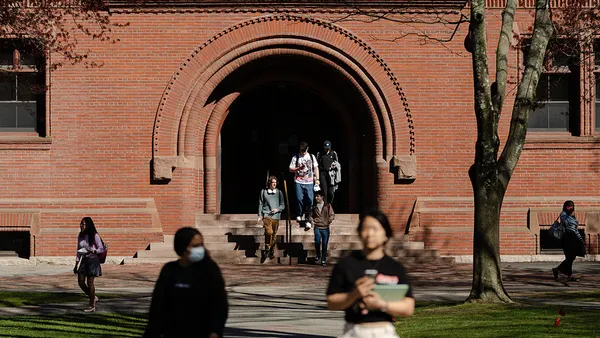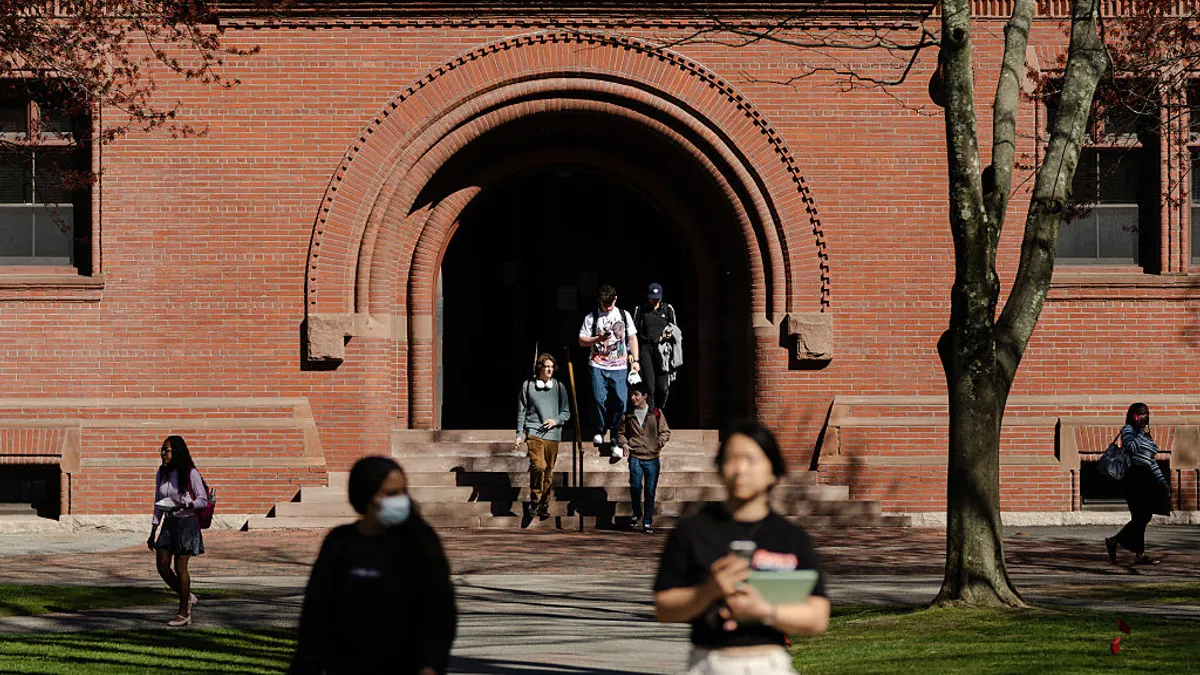
The U.S. Equal Employment Opportunity Commission on Tuesday ramped up its investigation into an agency charge that Harvard University allegedly follows a “comprehensive plan to discriminate against white, Asian, male, non-black, non-Hispanic, non-Native American, and straight employees” in faculty-related positions on the basis of race and gender.
EEOC sued the Cambridge, Massachusetts, institution to enforce a subpoena requiring Harvard to hand over hundreds of documents the EEOC asserts are needed for the investigation.
In EEOC v. Harvard University, EEOC argued that “despite [its] good faith attempts to engage Respondents,” Harvard “continues to withhold information,” and the agency “is simply seeking” to determine whether the university violated Title VII of the Civil Rights Act of 1964. EEOC said the documents are relevant because they “cast light” on trends that form the basis of its allegation Harvard engaged in a pattern or practice of discrimination based on diversity, equity and inclusion objectives.
EEOC’s actions targeting Harvard’s DEI practices are consistent with recent actions the agency has taken against other high-profile employers, including Nike, the city and county of San Francisco and The New York Times.
In a June petition (attached to the EEOC’s lawsuit), Harvard disputed the validity of the subpoena, which it said includes more than 700 separate requests involving hundreds of individuals, as well as the validity of the underlying charge. Harvard argued that the cost and burden of complying with the subpoena would impair operations across its 13 colleges and “outweigh the minimal relevance of information sought, particularly given the lack of any specific aggrieved individual [and] the vague and indefinite nature of the Charge.”
The university also disputed that EEOC acted in good faith and accused the agency of engaging in a “virtually boundless and impermissible fishing expedition,” the petition said. Harvard claimed it has given the EEOC more than 9,000 pages of responsive information and provided the agency with a list of 68 days, “totalling hundreds of hours,” when it could meet and confer about the requested documents.
Harvard further claimed the charge and subpoena are a retaliatory attempt at “ratcheting up” pressure against it “to get it to cave to the Administration’s ideological demands.” The petition asked the court to revoke or modify the subpoena.
In April 2025, EEOC Chair Andrea Lucas charged the university with possibly engaging in disparate treatment discrimination since 2018 “to achieve, in Harvard’s own words, ‘demographic diversification of the faculty,’” the agency explained in a memorandum supporting the subpoena.
The charge alleged that Harvard pursued its goal of having a diverse faculty through recruiting, development and promotion practices “expressly directed at employees of ‘underrepresented and diverse backgrounds’ to the exclusion of all others.” This goal allegedly extended to Harvard’s medical school and affiliated hospitals and included student employees and trainees, the EEOC said.
The subpoena seeks documents related to any hiring committee guidance since 2018, the minutes and agendas of various diversity offices and groups, and the establishment of a “Diversity and Inclusion Fellow Program,” internal and external discrimination complaints from certain groups, and more. The EEOC is also seeking detailed information about faculty and tenure applicants and hiring officials allegedly responsible for implementing faculty diversity goals, according to the memorandum.
Last month, the EEOC sought enforcement of a subpoena related to its investigation of a San Francisco DEI training seminar. The investigation began in 2024 after an employee claimed the external instructor made repeated derogatory remarks about White people and White women. The EEOC said San Francisco produced some of the required documents but withheld others.
In August, at the EEOC’s request, a judge dismissed its case requesting Nike be forced to comply with a subpoena related to alleged discrimination against White employees, job applicants and training program participants. The EEOC said Nike provided the requested information.
In an ongoing lawsuit, The New York Times faces EEOC allegations of race and sex discrimination for not promoting a longtime White male editor to a deputy editor position in favor of an outside non-White woman allegedly with little experience in the beat.