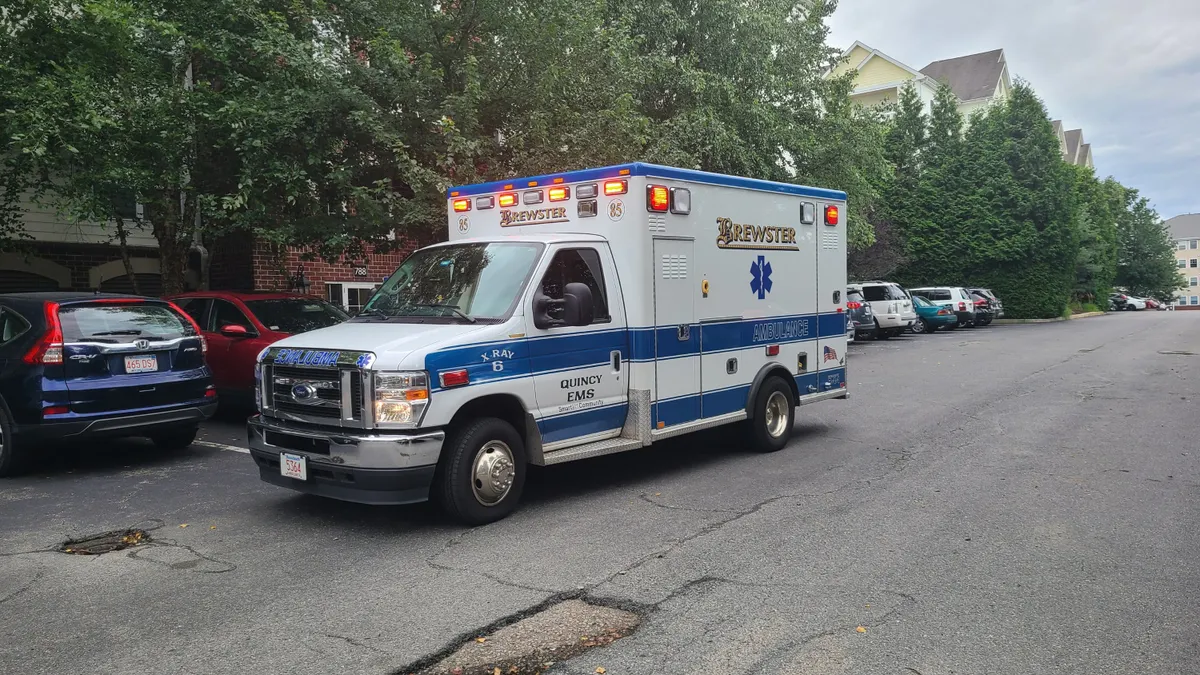
Dive Brief:
- No reasonable jury could conclude that Brewster Ambulance Service discriminated against a deaf applicant when it determined that no reasonable accommodation existed which would have allowed the plaintiff to perform the essential functions of a driver position without undue hardship, the 1st U.S. Circuit Court of Appeals held Monday.
- The position to which the plaintiff in Buccieri v. Brewster Ambulance Service, Inc. applied required frequent communication with patients, dispatch and medical facilities. Asked how he could fulfill such duties, the plaintiff requested an accommodation in the form of a service, operated via phone, that would connect to an American Sign Language interpreter who could then relay conversations between the plaintiff and dispatchers.
- Brewster extended a verbal offer to the plaintiff, but various parties expressed concerns about the accommodation’s sufficiency. Brewster later rejected the plaintiff, who sued alleging discrimination under the Americans with Disabilities Act. The jury entered a verdict partly in favor of Brewster. A Massachusetts federal district court granted Brewster’s motion for judgment as a matter of law, ruling for the company on all counts, and the 1st Circuit affirmed on appeal.
Dive Insight:
The 1st Circuit’s decision included an in-depth analysis of internal communications between hiring managers and executives at Brewster regarding the company’s attempts to accommodate the plaintiff and engage in an interactive process. Such documentation is critical to defense against ADA claims, legal experts have said.
According to court documents, a regional manager arranged for the plaintiff to take a ride-along with a Brewster supervisor after the verbal offer was made. The manager sent an email to a Brewster HR manager in which he noted the supervisor’s concerns following the ride, including that the plaintiff would not be able to communicate with clients and staff.
After this, Brewster sought other potential driver roles, but staff determined that similar concerns about performance of essential functions existed. Attempts to find a job for the plaintiff in another department also failed.
Brewster sent an email to the plaintiff and his career resource specialist outlining its concerns about the plaintiff’s ability to perform the driver role as well as its attempts to find an alternative position. It also invited the plaintiff to ask additional questions and discuss additional accommodations, but the plaintiff admitted that he did not follow up on this invitation.
Ultimately, however, the court’s decision turned on whether reasonable accommodation would allow the plaintiff to perform the essential functions of the driver role absent undue hardship to Brewster. Such an accommodation did not exist, per the court. At trial, the jury also sided with Brewster on the question of whether the proposed relay service accommodation would have caused undue hardship or posed a direct threat to the plaintiff or others.
The plaintiff “presented no evidence to rebut that his proposed tablet-based or any cell-phone-based accommodation for communicating with dispatch, even if it was available at the relevant time, would pose safety risks to all concerned of the driver's eyes being taken off the road, risks the ADA did not require Brewster to undertake,” the 1st Circuit said.
The court’s decision is noteworthy given other recent cases in which employers faced failure-to-accommodate allegations with respect to applicants and employees with hearing disabilities.
For example, the 8th U.S. Circuit Court of Appeals upheld a jury verdict in favor of such an applicant last year, finding that the jury correctly determined that a trucking company failed to propose or investigate any accommodation that could have helped the plaintiff perform essential job functions.
In May, Walmart agreed to settle a U.S. Equal Employment Opportunity Commission lawsuit alleging that it refused to accommodate and failed to hire a deaf applicant who allegedly requested an ASL interpreter for his interview with the company but never heard back.