Dive Brief:
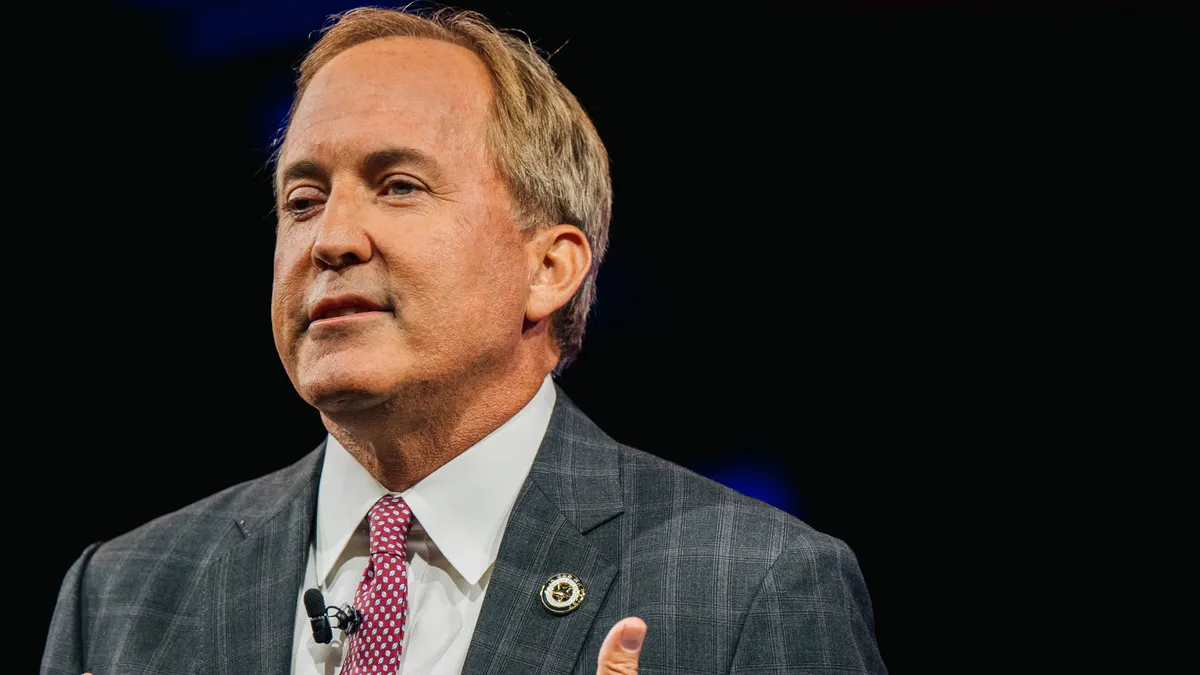
- Texas Attorney General Ken Paxton issued demands to 30 businesses as part of a broad probe of alleged H-1B visa program fraud, according to a statement Thursday.
- Paxton’s office claimed that several of the employers operated “ghost offices” in order to falsely represent active operations and sponsor foreign workers for visas. The Civil Investigative Demands, or CIDs, asked employers to identify all of their employees and provide records for specific products and services, financial statements and other communications.
- Paxton previously announced an H-1B fraud investigation into state businesses in January, a move that also referenced alleged ghost office operations. “I will not allow the H-1B program to be abused by bad actors seeking to use it as a loophole for allowing foreign nationals to invade Texas,” Paxton said in Thursday’s statement.
Dive Insight:
The second Trump administration has heavily scrutinized the H-1B visa program, and employers that depend on the program for talent have had to adjust. Texas is one of the few states to have launched similar legal enforcement efforts.
At around the same time that Paxton announced January’s investigation, Texas Gov. Greg Abbot ordered the state’s public colleges and universities to freeze all new H-1B applications through May 2027, Higher Ed Dive reported. Abbott also ordered the institutions to disclose how many new 2025 H-1B petitions and renewals they submitted in an effort to determine their commitment to providing equivalent positions to Texas job candidates.
Florida’s Board of Governors similarly approved a 10-month freeze on H-1B hiring at public universities in an effort backed by Gov. Ron DeSantis. In Iowa, state legislators have advanced a bill that would prohibit state universities from employing H-1B visa holders who are citizens of nations designated as foreign adversaries or state sponsors of terrorism by the U.S. government.
Thursday’s announcement named employers under investigation, including Tekpro IT LLC, Fame PBX LLC, 1st Ranking Technologies LLC, Qubitz Tech Systems LLC, Blooming Clouds LLC, Virat Solutions, Inc., Oak Technologies Inc. Techpath Inc. and Techquency LLC. None of the firms immediately responded to requests for comment.
Meanwhile, President Donald Trump has made significant changes to the H-1B program at the federal level, perhaps the most notable of which is a proclamation imposing a $100,000 fee on all new H-1B petitions filed on or after Sept. 21, 2025. The decision faces several lawsuits from employers and advocacy groups, but only one court has ruled on the policy; a Washington, D.C., federal judge held in December that the proclamation did not exceed Trump’s authority.
Additionally, the U.S. Department of Homeland Security proposed new rules altering the process by which new H-1B petitions are selected. Specifically, DHS’ rule created a four-tier wage scale into which new registrations are sorted, granting higher-paying offers a greater number of entries in the agency’s selection lottery.
Both of the changes are expected to increase the expense of employing H-1B visa holders, attorneys previously told HR Dive, and some organizations may shift to offshoring or pivot to other options as a result.
Despite the whirlwind surrounding the program, employers still hit the fiscal year 2027 cap on H-1B visa petitions at the end of March, U.S. Citizenship and Immigration Services announced.