Dive Brief:
- A new proposed rule issued by the Trump administration would amend federal regulations in order to expand employers’ ability to offer certain fertility benefits to employees, the U.S. Department of Labor announced Sunday.
- Under the rule, benefits used for diagnosis, mitigation or treatment of infertility or infertility-related reproductive health conditions would be recognized as “limited excepted benefits” similar to certain dental and vision benefits. The rule would set a combined lifetime maximum cap of $120,000 for participants and their beneficiaries, and this amount would be indexed for inflation from 2028 onward.
- As part of the proposal, benefits would be exempt from some requirements of the Affordable Care Act and other federal health coverage laws, DOL said. The rule is a follow-up to the administration’s October 2025 guidance that permitted employers to offer standalone fertility treatment benefits.
Dive Insight:
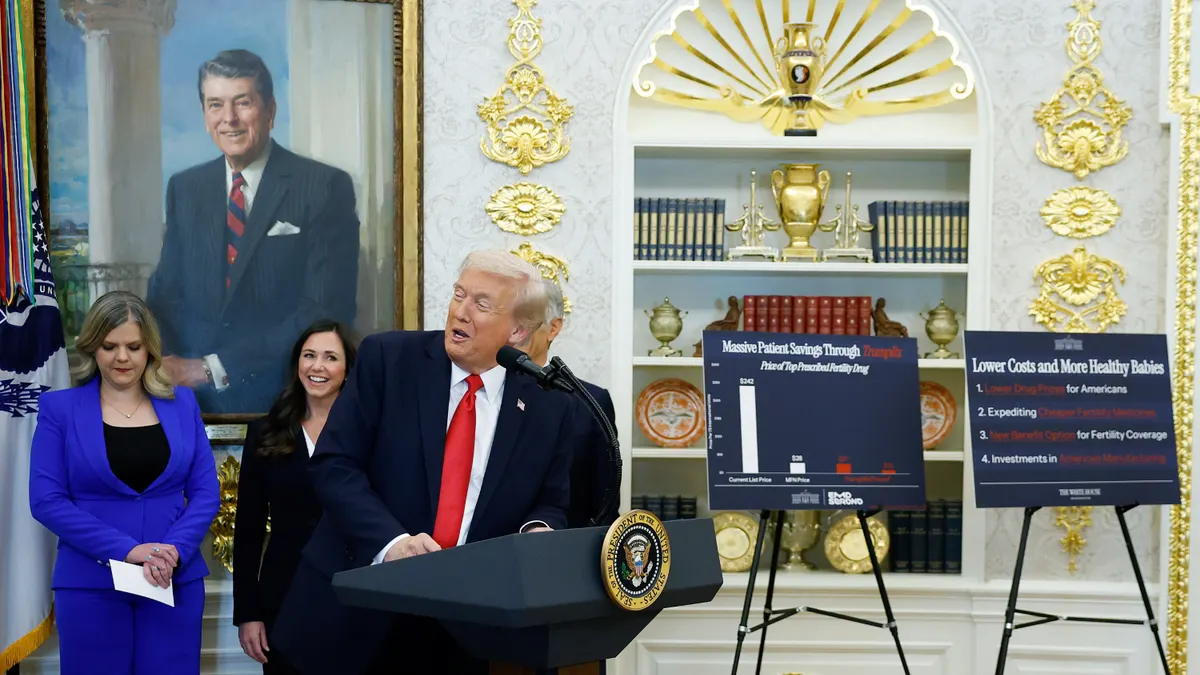
President Donald Trump has made fertility benefits coverage a key plank in his labor agenda, writing in a February 2025 executive order that the expense of fertility treatments — namely in vitro fertilization, which the order said can cost $12,000 to $25,000 per cycle — had made infertility “an emotional and financial struggle.”
Sunday’s joint proposed rule, issued by DOL and two other federal agencies, is intended to build upon Trump’s order and address declining birth rates, Acting Labor Secretary Keith Sonderling said in a press release. The rule’s text cited Centers for Disease Control and Prevention data showing that the number of U.S. births fell by 9% between 2014 and 2024, while 1 in 5 Americans experienced infertility.
“President Trump is committed to expanding access to fertility benefits so that more American families can have children, building on his longstanding efforts to support family formation and stability,” Sonderling said.
Though fertility benefits have gained prominence in the employee benefits space in recent years, adoption remains relatively low. A 2024 survey by the International Foundation of Employee Benefits Plans found that 42% of employers offered fertility benefits that year, with smaller shares hosting specific offerings such as coverage for IVF, fertility medications and genetic testing.
The administration’s 2025 guidance specified that employers could offer fertility benefits as a separate form of excepted benefit, known as “independent, noncoordinated excepted benefits,” provided the benefits met certain conditions. The same guidance noted that fertility benefits also could be offered as limited excepted benefits via health reimbursement arrangements, or HRAs.
In a 2025 analysis, the American Society for Reproductive Medicine wrote that the administration’s guidance provided employers a “manageable way to support fertility care” but noted the limited financial scope of the benefit types specified, concluding that such benefits do not provide or replace comprehensive fertility coverage. ASRM also said that the coverage pathways specified were voluntary for employers.
“This leaves open questions about whether lower-income workers, those with self-insured plans, or historically underserved populations will actually gain meaningful access to fertility care,” ASRM said in its analysis.
At press time, the proposed rule announced May 10 had not yet been published in the Federal Register. The agencies said a 60-day public comment period would begin after publication.
In tandem with the release of the fertility benefits proposal, the U.S. Department of Health and Human Services announced the launch of Moms.gov, a federal website with resources and information for new and expectant mothers.