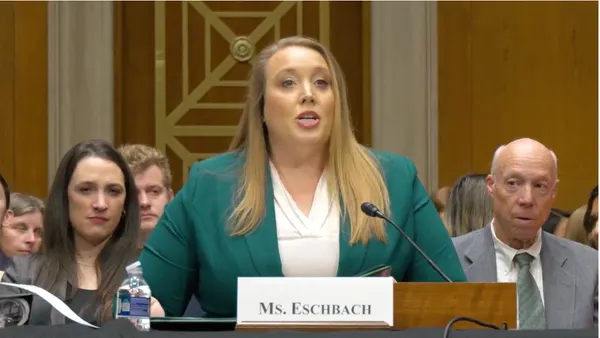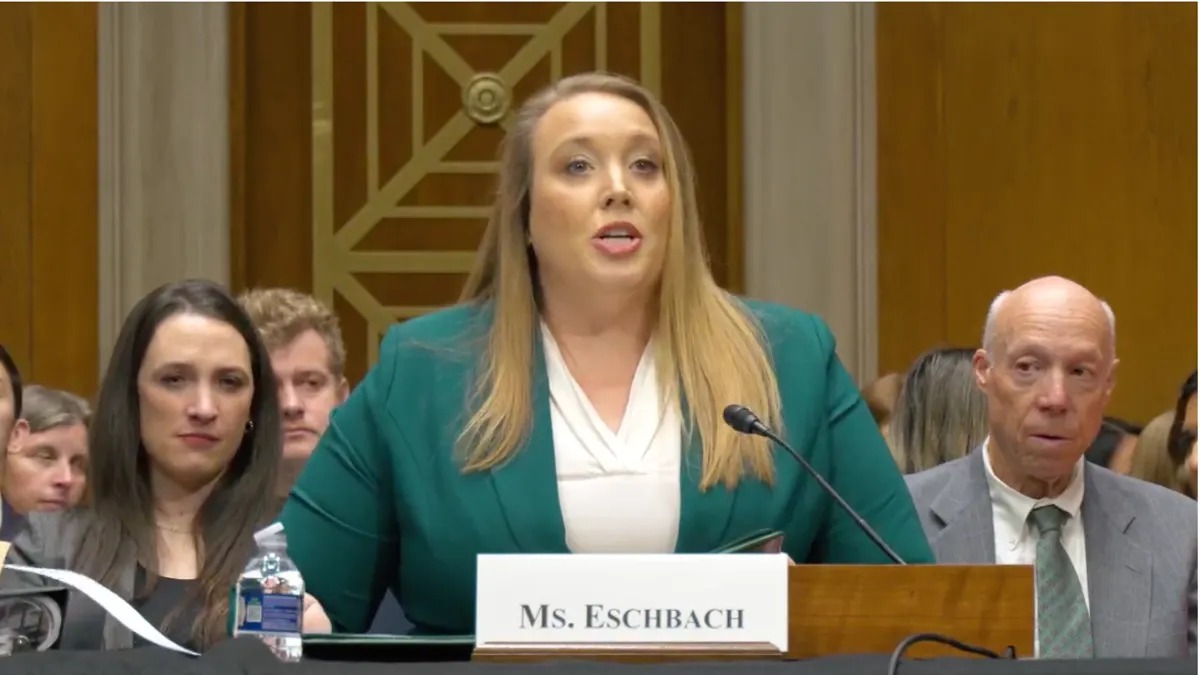
The Senate Committee on Health, Education, Labor and Pensions focused on several controversial aspects of the U.S. Equal Employment Opportunity Commission’s conduct over the past two years during a Tuesday confirmation hearing on the nomination of Catherine Eschbach for general counsel of the agency.
Senators’ questions, which spanned from gender identity discrimination and disparate-impact discrimination to artificial intelligence and pregnancy protections, provided a hint at what a majority-Democratic Congress might turn its attention to when it comes to compliance issues come January.
Eschbach, who was appointed EEOC principal deputy general counsel in September 2025, opened the 35-minute hearing by saying she looked forward to “building on the important work already underway” at the agency. Her priorities, she said, would be continuing President Donald Trump’s “merit-based civil rights agenda” and the priorities outlined by the agency’s national enforcement plan, including “DEI-based discrimination,” national origin discrimination against American workers, protecting women and protecting the rights of religious Americans.
Eschbach evades questions on gender identity discrimination
In light of EEOC’s abandonment of lawsuits on behalf of LGBTQ+ workers, Sen. Tammy Baldwin, D-Wis., attempted to pin down Eschbach’s views on how Title VII of the Civil Rights Act of 1964 applies to gender identity and sexual orientation discrimination — with little success.
“Do you believe that the EEOC has a responsibility to protect workers who have been fired based on gender identity or sexual orientation?” Baldwin asked.
“I am committed to enforcing the laws that are within the EEOC’s jurisdiction, consistent with their statutory authority on behalf of all American workers,” Eschbach said.
“So that’s a yes?” Baldwin pressed, to which Eschbach repeated her response.
Baldwin tried a different tactic, asking if EEOC is responsible for protecting workers from workplace harassment based on their gender identity or sexual orientation.
Eschbach repeated she was “committed to enforcing the laws on behalf of all Americans as the statutes we enforce hold,” before conceding that the U.S. Supreme Court’s Bostock v. Clayton County, Ga. decision did apply Title VII to such groups “in the termination context.”
“If confirmed, do you plan to bring cases of workplace discrimination for … allegations related to hiring, firing, promotions, sexual harassment, or pay discrimination based on gender identity?” Baldwin tried again.
Eschbach replied that she would commit to evaluating every case based on merit, factual sufficiency and whether it was an appropriate use of commission resources.
Disparate impact pushback
Sen. Tim Kaine, D-Va., protested the agency’s abandonment of disparate-impact discrimination claims, calling such claims a “really important” element of civil rights laws and drawing a hypothetical scenario of an employer that as a rule rejects any applicant who had been absent from a previous job more than 20 days in any year — thereby disproportionately screening out women and people with disabilities.
Kaine asked whether the agency, before closing pending charges based on allegations of disparate impact, assessed whether these cases had merit.
Eschbach said the decision had been made prior to her appointment and emphasized that her role would be as a litigator rather than a commissioner, with the latter taking on the agency’s “policy-making features.”
“Do you follow the commission’s directives or the law?” Kaine asked. “What is the oath that you will take?”
“I will uphold the law and the Constitution,” Eschbach said.
“I don’t think there's anything in your oath that says, ‘I will do whatever the EEOC commissioners tell me,’” Kaine said, before shifting to Eschbach’s time at the Office of Federal Contract Compliance Programs.
Spotlight on a controversial agency lawyer
Maryland Sen. Angela Alsobrooks, another Democrat, fixed her scope on assistant general counsel Benjamin North — a direct report to Eschbach.
“Are you aware that Mr. North was the subject of a Title IX investigation by his university after being credibly accused of rape by a fellow student in 2014?” Alsobrooks asked. “And are you also aware that he was suspended for two and a half years following that investigation?”
The worker, Eschbach said, “had to prove to the Virginia State Bar by … clear and convincing evidence that he was of good moral character and fit to practice law” in order to be admitted to the state bar.
Alsobrooks asked whether Eschbach knew of the investigation and whether it is appropriate for someone “credibly accused of sexual assault” to lead cases at the EEOC, to which Eschbach repeated that North needed to provide “clear and convincing evidence that he was of good moral character and fit to practice law.”
According to reporting by The Intercept, North maintained his innocence and later sued his college over the suspension.
Concerns on pregnancy protections
In the last few minutes of the hearing, Sen. Baldwin pivoted to the Pregnant Workers Fairness Act, asking if Eschbach believed it was unlawful to fire a worker for having an abortion.
“The Department of Justice, on EEOC’s behalf, in a 5th Circuit filing, took the position that the Pregnant Workers Fairness Act would not cover abortion,” Eschbach said. The 5th U.S. Circuit Court is reconsidering a challenge to the enforcement of the PWFA based on an argument that the legislation was not validly passed because fewer than half of those voting were physically present at the time, with others relying on proxy voters.
“What can you tell me, if anything, about promulgation of new guidelines under that law?” Baldwin asked.
“Any regulatory changes would be enacted by the commissioners,” Eschbach said, just before Sen. Bill Cassidy, R-La., wound down the hearing.
While Democrats led the majority of questions addressed to Eschbach, Cassidy, chair of the HELP Committee, also asked about balancing pattern-or-practice cases with individual cases and about how the agency views cases involving AI tools.
Eschbach said balancing cases would depend on the context and confirmed that discrimination laws apply regardless of what tools employers use. She pointed to an agency lawsuit and settlement with an e-learning company, in which EEOC alleged the company’s recruiting software algorithm screened out older applicants.
“Regardless of how employers go about making their employment decisions, the antidiscrimination laws are going to apply to them,” Eschbach said — one moment of likely bipartisan agreement.