It would likely be an understatement to say that the diversity, equity and inclusion landscape has changed over the last five years.
An explosion of funding and proliferation of anti-racism training gave way to a wave of corporate DEI rollbacks, with plenty of Fortune 500 companies leading the way.
Following President Donald Trump’s slew of anti-DEI executive orders affecting both the private and public sectors, management-side attorneys generally advised their clients to rely on Title VII of the Civil Rights Act to support their initiatives. In fact, HR’s top DEI priority in 2026 was making talent programs scrutiny-proof, according to experts.
But even for those employers committed to DEI as a value and confident in their program’s legality, a branding question remains: What’s at stake when a company conveys — or declines to convey — their DEI stance to the public?
Risks abound
Employers know they may face risk regardless of the DEI path they choose, attorneys have previously told HR Dive. Visible DEI commitments have some employers worried they may draw the Trump administration’s ire.
But without those commitments, employers are “less able to find the best person for the job and ensure that all employees are performing to their highest potential,” Emily Martin, chief program officer for National Women's Law Center, told HR Dive via email.
“Even worse, abandoning these efforts makes unlawful harassment and discrimination more likely,” she added, saying that this talent approach could open up employers to increased risk of “legal liability, reputational damage, and the productivity losses that stem from toxic workplaces."
Similarly, Aimee Peoples, VP for diversity, equity, inclusion and anti-racism at National Partnership for Women and Families, said that when companies step away from DEI, they’re stepping away from “protections that help women earn fair pay [and] stay safe from workplace harassment, access leadership opportunities, and balance caregiving with careers.” Peoples underscored that DEI helps veterans find civilian work and helps people with disabilities achieve equal access, as well.
A company’s reputation may suffer, too. The consumer reaction to a change in talent strategy from Target provides a concrete case study for HR professionals on the reputational risk of stepping back from DEI.
A case study in the Target boycott
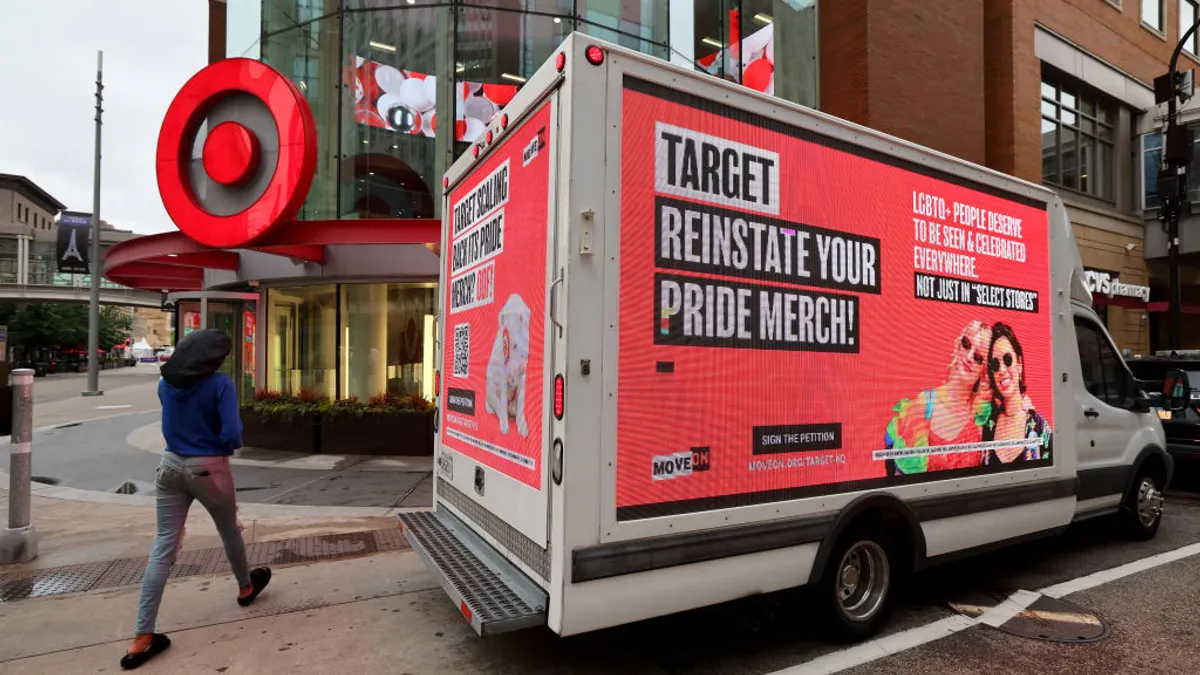
Last year, during Black History Month, #BoycottTarget was trending in response to the retail giant’s highly publicized step back from inclusion. Initially, two organizing rights collectives called for a monthlong boycott of Target; it ultimately stretched more than a year due to outrage momentum. Cultural leader Rev. Jamal Bryant called for the end of the Target boycott in March citing productive conversations. Bryant did not respond to a request for comment.
While there were various factors at play, many business analysts have suggested Target boycott drove consumers away, leading to a fall in earnings and a decline in year-over-over foot traffic.
Target’s market valuation is around $54 billion today. That’s less than half of its almost $130 billion valuation in August 2021 — the height of renewed corporate commitment to DEI following the murder of George Floyd the year before. Meanwhile, Costco — an employer that stayed the course on DEI despite pressure from shareholders and state attorneys general — saw the opposite trajectory. In August 2021, Costco’s valuation was around $200 billion and has risen to more than $442 billion today.
Costco has leaned into championing employee experience and embracing its workers publicly, an approach that has seemingly boosted consumer loyalty. In a reverse image of the Target case study, Rev. Al Sharpton held a “Buy-Cott” last February to encourage consumers to patronize Costco, in celebration of its continued commitment to DEI.
“Companies that abandon diversity, equity and inclusion are shooting themselves in the foot,” according to Jessica González, co-CEO of media advocacy organization Free Press, which earlier this year examined how mainstream media sources were changing their strategies in response to Trump’s anti-DEI agenda. “As the United States grows increasingly diverse, and companies seek international markets, homogenized workplaces that fail to reflect the full spectrum of human experience will be at a major disadvantage,” González told HR Dive via email.
A spokesperson for Target told HR Dive that the company has a “longstanding commitment to creating growth and opportunity for all.”
“We work every day to unlock potential by empowering entrepreneurs, supporting small businesses and investing in our team members,” the Target spokesperson said. “Since our founding, we’ve known that our strength is tied to the strength of the 2,000+ communities we serve – which is why we donate 5% of our profits each year and volunteer over 1 million hours. We’re committed to showing up as trusted neighbors while delivering results for our team, guests and communities.”
Target became a focus for consumers amid widespread DEI rollbacks perhaps because of its earlier commitments, according to Jasmin Hartmeier, senior director of public relations at Chemistry Cultura, the Latino division of PR firm Chemistry. She highlighted how Target pledged in 2021 to boost Black employee representation by 20% over the next three years and to spend $2 billion with Black-owned businesses by the end of 2025.
“Once Target rolled back its DEI-focused commitments, it understandably had many Americans questioning exactly where the company’s loyalty lies,” Hartmeier told HR Dive over email. “After all, if any company publicly announces an organizational value, only to walk it back a few years later, then that was never a real company value – it was simply about being part of a corporate America trend.”
Post-Target branding
Target’s values were perhaps “not what we thought they were,” Craig Crisler, CEO of SupportNinja, told HR Dive. “If you really, truly believe in your values and what your core values are as an organization, you stand by them, even [during] the winds of potential change.”
For Crisler, who runs a customer support outsourcing firm, DEI is integral to the work. SupportNinja operates in Colombia, Ireland, Philippines, Romania and Singapore, along with the U.S. “I joke in the outsourcing space: If you don't really believe in DEI, you shouldn't be working in outsourcing, because, by nature, you're diverse.”
Apart from DEI being an employee experience tenet that Crisler and his team hold dear, he advocates for C-suites to stick with DEI because stepping back from it can alienate potential employees.
“If you don't kind of lean into that DEI lens [in] how you portray yourself publicly, you're cutting out groups that you could have talent, that could be potentially available to you,” Crisler said. “Really smart people may look at you and say, ‘Oh, these guys don't lean into the idea that we all should be existing here together.’”
Recent research supports Crisler’s theory: many employees report greater satisfaction at work when they work for an employer whose values align with their own, according to a 2025 Deloitte analysis.
Crisler acknowledged that even if HR professionals want to stand firm on DEI, circumstances — such as being a federal contractor — can complicate that.
In all cases, however, alignment is crucial; Crisler said CHROs should assess how their leadership team sees DEI: “Do they see it as a benefit or a problem?”
Internal and external alignment is similarly crucial, according to Hartmeier. If DEI is part of an employer’s brand, “you must first do the right thing behind closed doors,” she said. “All the glitzy PR and marketing efforts will fall flat if the inclusive commitments and values are not up and running behind the scenes.”