Dive Brief:
- Women make up 47% of the total workforce, but they comprise 83% of people employed in artificial intelligence-vulnerable occupations, according to a National Partnership for Women and Families report.
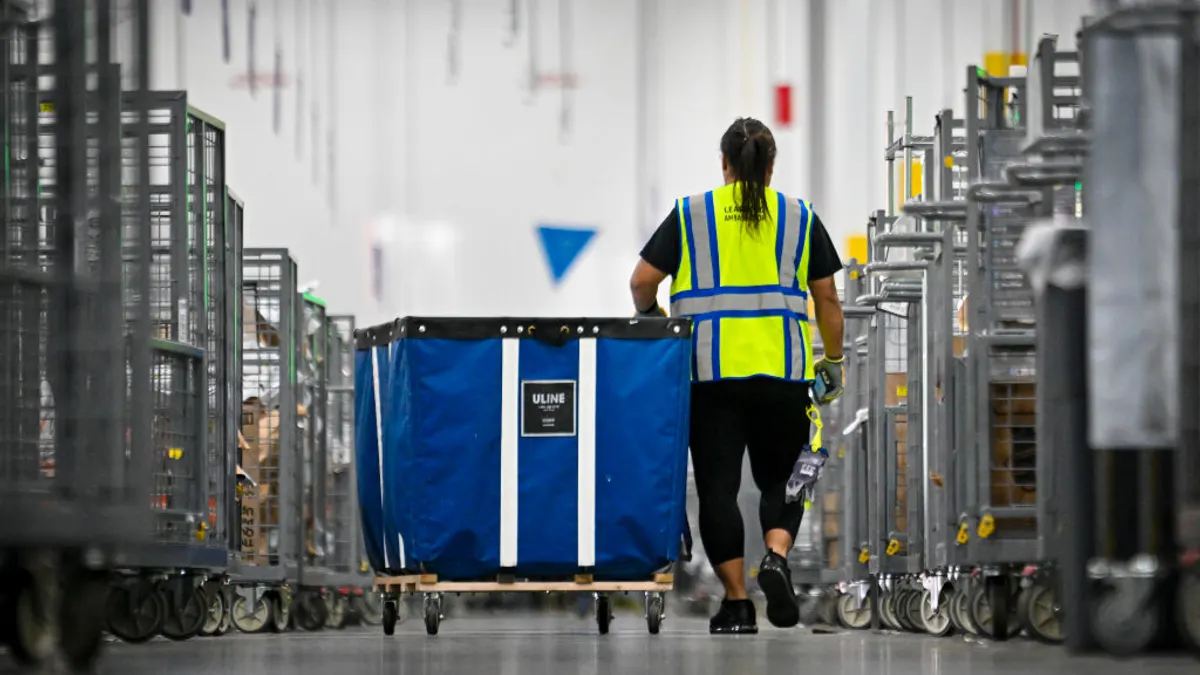
- Additionally, women of color make up 31% of workers in the 15 most AI-vulnerable jobs. This includes work on gig economy, nursing and warehouse work platforms, where “algorithmic systems dictate nearly every aspect of the workday,” per the report.
- Black and multiracial women’s share of the most AI-vulnerable jobs is more than one and a half times larger than their representation in the overall workforce.
Dive Insight:
While AI is reshaping the workforce at large, researchers said certain groups are dramatically overrepresented in the most AI-vulnerable jobs. For White women, Latinas, and American Indian and Alaska Native women, their share of the most AI-vulnerable jobs is nearly double that of the overall workforce.
Workers in those jobs are least likely to be able to adapt and transition to new work, researchers said. Furthermore, as generative AI develops at an increasingly rapid pace, workers are often being forced to deal with new variations of bias and harassment, as well as concerns about privacy and transparency.
As AI is beginning to change American workplaces, work still needs to be done to make those workplaces fair and equitable to women, particularly women of color, Jocelyn Frye, president of NPWF, said in a statement.
“Because women are significantly overrepresented in positions such as secretaries, office clerks and receptionists, they will be uniquely affected by this technology,” Frye said. “Without clear standards and accountability, we risk reinforcing the same inequities that have shaped our economy for decades.”
Research indicates a gender gap between men and women exists when it comes to AI skills, training, job access and pay overall; likewise, DEI rollbacks are negatively affecting women’s opportunities regarding equity, salary transparency, protections against bias and harassment, and leadership opportunities.
Along with calling for more studies on AI in the workplace in order to protect women’s equity, NPWF also called for more legal oversight on AI.
“Right now, too many workers are navigating the use of AI in their workplaces without proper protections in place,” Tanya Goldman, senior fellow at NPWF, said in a statement. “Lawmakers have an opportunity — and a responsibility — to set clear rules that both support the responsible use of these tools and protect workers from harm.”