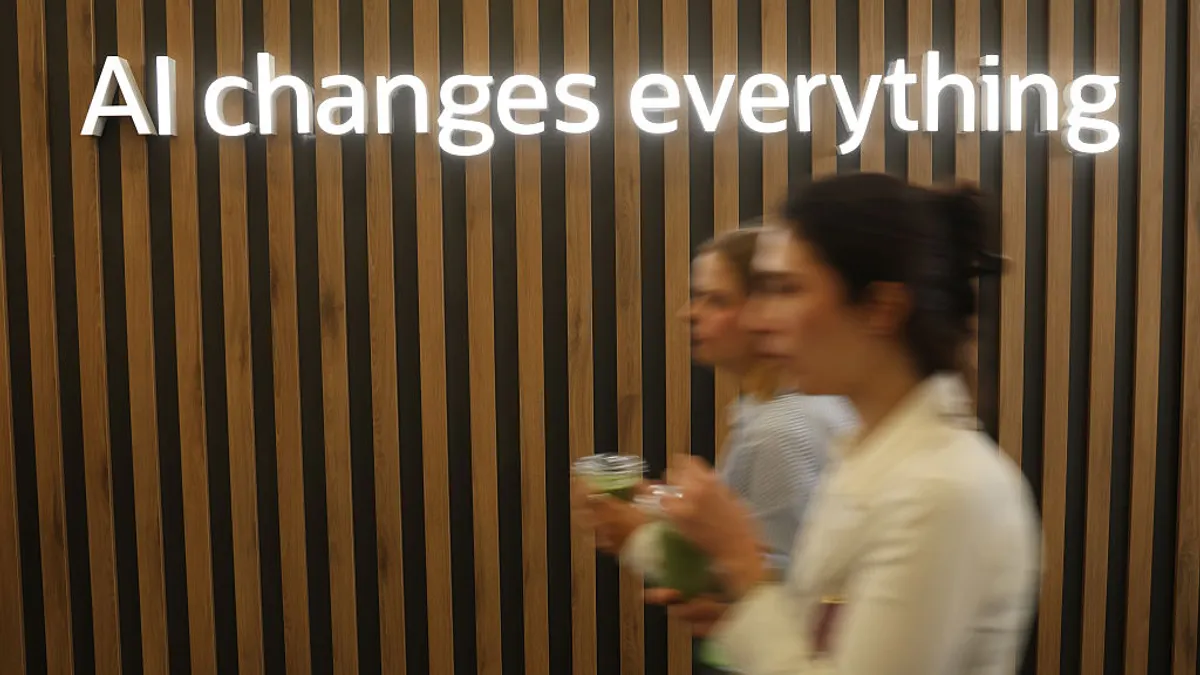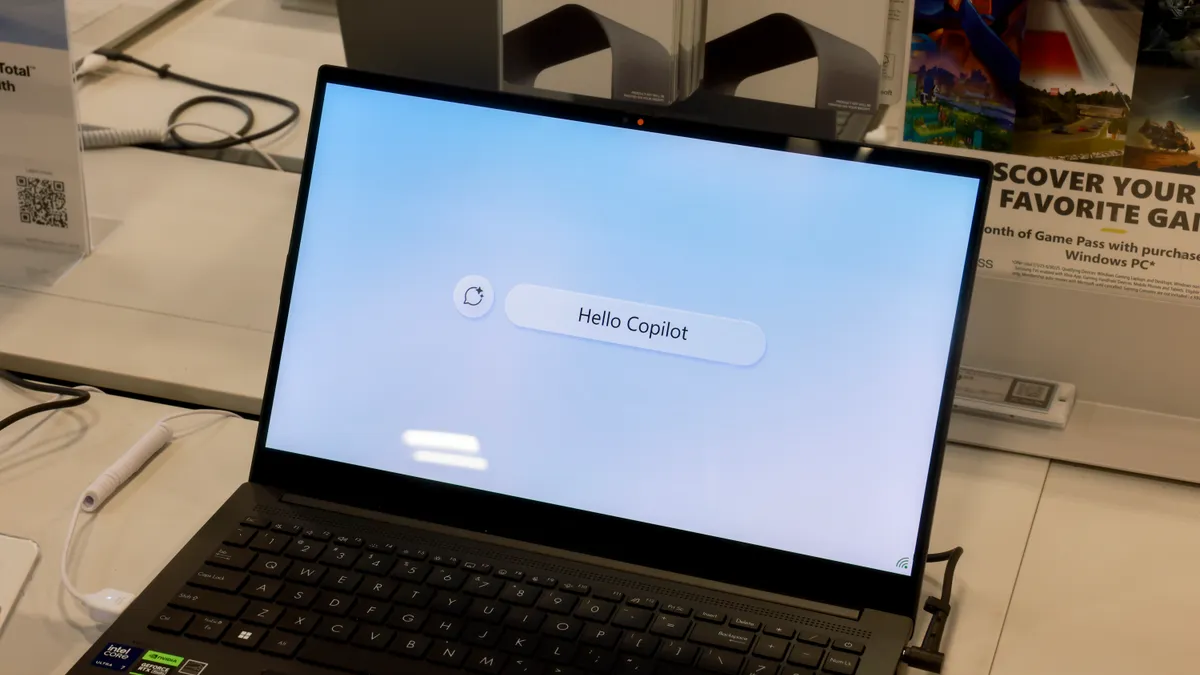
Another year in the artificial intelligence era of the workplace showed a continued focus on skills, credentials to verify those skills and upskilling workers on AI.
Yet learning budgets remained flat, employees were overwhelmed with too much work to find time for training, and fears about AI replacing jobs persisted.
As the calendar flips to 2026, how will learning and development evolve throughout the year? Experts in the field weighed in via email.
In 2026, skills will come first.
Aisling MacNamara, director of learning, enablement and inclusion at LearnUpon, a learning management system, believes that “learning strategies will shift decisively from content-first to skills-first.”
“As organizations place increasing emphasis on retention and internal mobility, learning teams will focus less on producing large volumes of content and more on identifying, developing, and tracking the skills that matter most to the business,” MacNamara said. “The question won’t be ‘What content do we build?’ but ‘What skills do we need to thrive?’”
Content will follow, but skills will lead, she said.
L&D will be a driver of strategic decisions.
Brendan Noud, CEO and co-founder of LearnUpon, predicts that learning teams will expand their influence by deepening their understanding of business priorities and speaking the language of revenue, performance and workforce resilience.
“In 2026, L&D will be a proactive partner in shaping workforce strategy by informing decisions about skills investment, culture transformation, and the capabilities needed for long-term growth,” Noud said. “In short, the era of L&D as a ‘support function’ is ending. The teams that embrace data, business alignment, and strategic collaboration will define what learning leadership looks like in 2026 and beyond.”
Learning will become a “business imperative.”
Organizations will “shift from treating learning as a benefit to treating it as a business imperative,” said Kian Katanforoosh, CEO and founder of Workera, an AI-powered skills intelligence platform.
Organizations typically track statistics like completion rates and time spent learning, “which tell you nothing about whether people are actually building the skills the business needs,” Katanforoosh said. In 2026, leaders will instead focus on answering three employee questions: What skills do I need to develop; by when; and how will I be rewarded for it?
“When incentives align with measurable skill growth, adoption follows. You get higher proficiency, faster learning velocity, and ultimately more agility across the business,” Katanforoosh said.
Potential will be prioritized over pedigree.
Over the next year, organizations will shift from traditional credentialing to competency-based hiring, Danielle McMahan, executive vice president and chief people officer at publishing company Wiley, predicts. Employers will prioritize transferable skills and potential over pedigree, especially in healthcare, renewable energy and skilled trades fields where demand is high, McMahan said.
Leaders’ skills will need to evolve.
As employees deal with a workplace where skill requirements are shifting, so too must leaders adapt, according to Melissa DiMuro, chief people, culture and marketing officer at building systems solutions provider Limbach.
“Just like the rest of our teams, leaders must learn new capabilities and be open to new approaches. Employees will expect personalized experiences from their leaders and companies,” DiMuro said.
Companies will need to show the ROI of AI.
The core HR challenge in 2026 will be showing that AI actually helps workers, said Marcy Klipfel, chief engagement officer at Businessolver, an employee benefits tech platform.
“If AI and data don’t reduce burnout, confusion, and financial stress for employees, they’re not delivering real ROI. Right now, employees see headlines about people being replaced by AI every month. That’s a trust issue, and it’s becoming a wellbeing issue,” Klipfel said.
To do this, employers will need to adopt “empathetic strategies that protect wellbeing, reduce risk, and show measurable returns,” per Klipfel.
“In 2026, the real metric for HR tech is simple: are people less stressed, less confused, and more confident? If the answer is no, the technology isn’t working — no matter how impressive the dashboard looks,” Klipfel said.
Companies will need to teach social skills.
As AI becomes more commonplace, employees newly entering the workforce may have “spent their formative years socializing and seeking advice from AI rather than humans,” said Chris Eigeland, CEO of Go1, an online learning library. “Their ability to navigate complex human interactions, read social cues, collaborate effectively and build genuine relationships will be fundamentally stunted.”
That’s a scenario that should alarm every leader and HR pro, Eigeland said.
“This creates an unexpected responsibility for organizations: Companies may need to play an active role in helping employees develop and maintain human social skills,” Eigeland said. “Organizations that recognize this challenge early and develop programs to address it will have a significant advantage in building effective, collaborative teams. Those who ignore it will struggle with a workforce that’s technically proficient but socially dysfunctional.”
Correction: In a previous version of this article, Danielle McMahan was misidentified. She is the executive vice president and chief people officer at Wiley.