Dive Brief:
- Twenty attorneys general filed a lawsuit (Maryland, et al. v. Hegseth et al.) challenging the March 26 executive order regarding diversity, equity and inclusion programs among federal contractors.
- The lawsuit alleges that President Donald Trump’s executive order impedes each state’s efforts to prevent racial discrimination and is unclear in what it prohibits. “Neither the Executive Order nor agency actions implementing it have provided any useful explanation of whether or how the contract term imposes requirements different from existing provisions of law,” the lawsuit alleges.
- The administration faces a similar lawsuit from a coalition led by the National Association of Diversity Officers in Higher Education. That group said the administration "put federal contractors in an impossible bind" between signing away their freedoms or abstaining from their business.
Dive Insight:
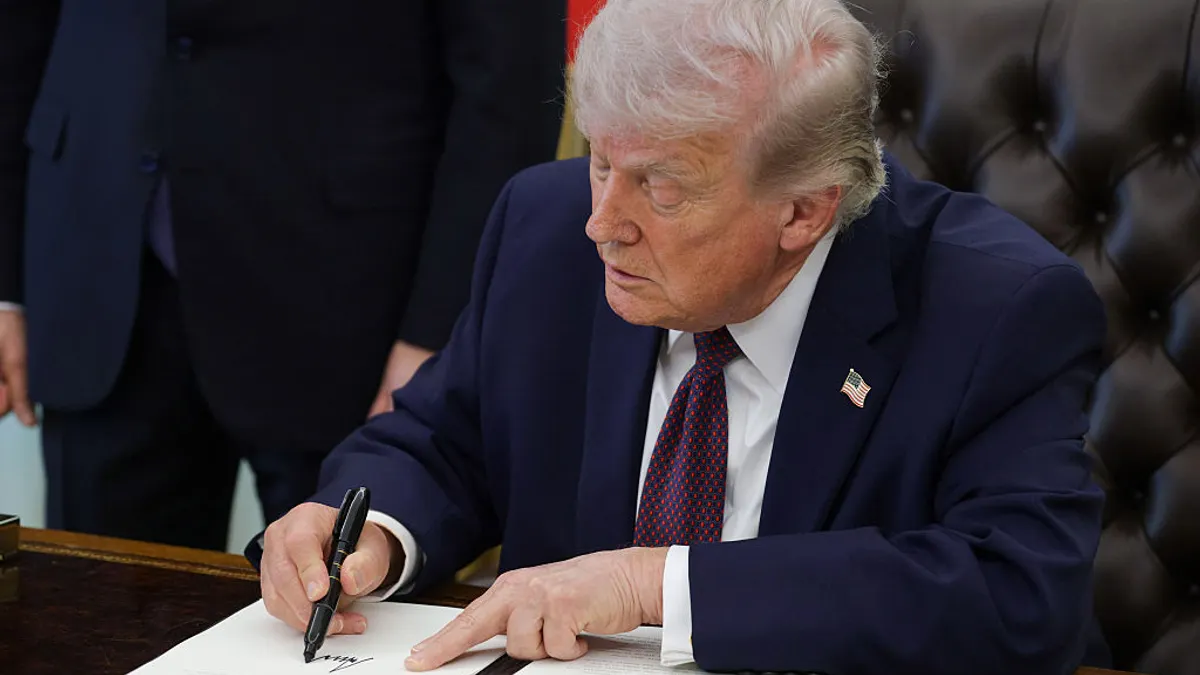
Trump’s executive order calls DEI-related initiatives “unethical and often illegal” and homes in on “disparate treatment” based on race or ethnicity in recruiting, employment and contracting.
In response, acknowledging that each state complies with all relevant antidiscrimination laws, the attorneys general stated that they “also have a strong interest in preventing, detecting and remedying racial discrimination within their own operations and more broadly.”
Plaintiffs also called the executive order “especially confusing” given President Lyndon B. Johnson’s 1965 executive order prohibiting racial discrimination among federal contractors.
The plaintiffs are the states of California, Colorado, Connecticut, Hawaii, Illinois, Maine, Maryland, Massachusetts, Michigan, Minnesota, Nevada, New Jersey, New Mexico, Oregon, Rhode Island, Washington, Wisconsin, Virginia and Vermont. Along with Pete Hegseth, the defendants include Acting Secretary of Labor Keith Sonderling, as well as a wide range of administration officials.
Notably, the March 26 executive order demanded that all federal contractors provide certain reports to agencies for review, including “books, records and accounts,” adding that should a contractor or subcontractor be noncompliant with the order, their contract “may be canceled, terminated, or suspended in whole or in part, and the contractor or subcontractor may be declared ineligible for further Government contracts.”
Regarding this week’s lawsuit, a White House spokesperson told HR Dive that Trump “has made his position clear” regarding his administration’s approach to merit.
“Individual dignity, hard work, and excellence made America the greatest country in the world, and DEI discrimination has no place in it. These practices are wrong, often illegal, and impose real costs on the American people,” the spokesperson said. “When the federal government contracts with companies that engage in them, taxpayers foot the bill.”