
Dive Brief:
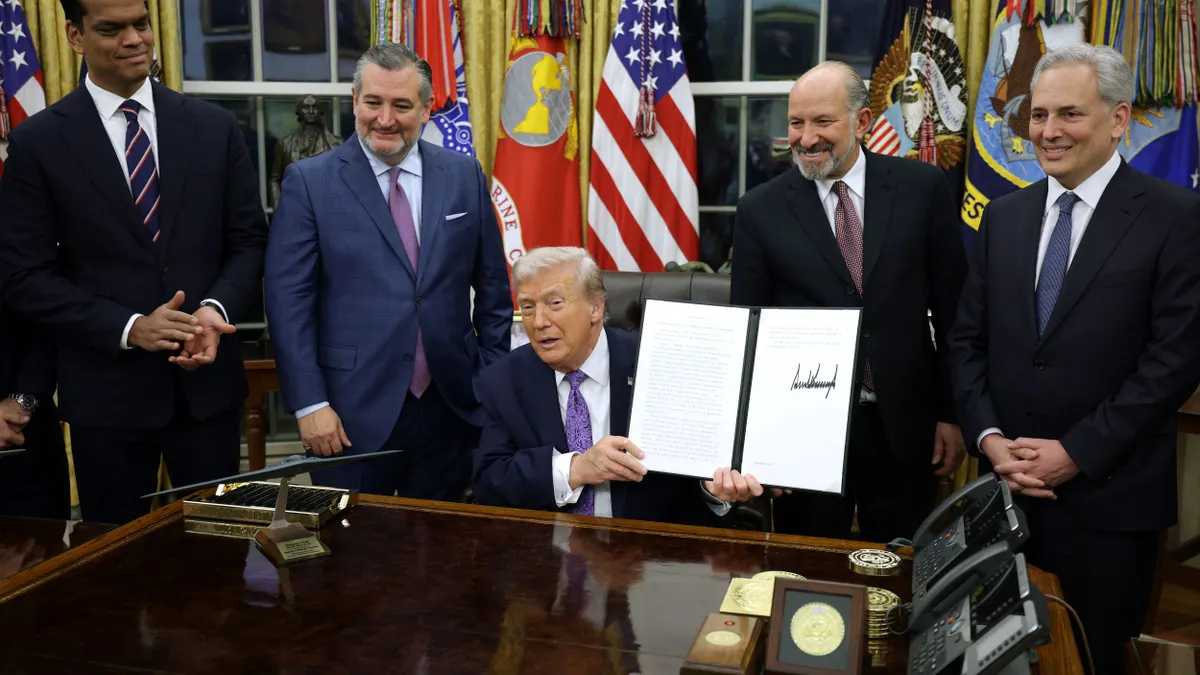
- U.S. businesses need to be prepared to navigate a “fluctuating and unstable regulatory landscape” in the wake of President Donald Trump’s recent executive order seeking to block certain state artificial intelligence laws, according to a legal analysis.
- Critics such as the American Civil Liberties Union say that parts of the order raise constitutional issues, such as a section calling for states with “onerous” AI laws to be denied funds from the federal government.
- “Given the legal uncertainty and potential challenges to the EO, it is important to note that existing state AI laws remain enforceable,” attorneys at Roanoke, Virginia-based law firm Woods Rogers Vandeventer Black said in a Monday blog post. “But whether states will actually enforce their AI regulations in the wake of the EO remains to be seen.”
Dive Insight:
Trump’s order says that state AI laws “sometimes impermissibly regulate beyond State borders, impinging on interstate commerce.”
The Thursday order, which has prompted mixed reactions, tasks U.S. Attorney General Pam Bondi with creating an AI Litigation Task Force within 30 days to challenge state AI laws that “unconstitutionally regulate interstate commerce” or clash with existing federal laws.
Within 90 days, Commerce Secretary Howard Lutnick must issue a policy specifying the conditions under which states may be eligible for remaining funding under the Broadband Equity Access and Deployment Program. Under the policy, states with onerous AI laws must be deemed ineligible.
The president also called on David Sacks, White House special advisor for AI and crypto, and Michael Kratsios, assistant to the president for science and technology, to jointly recommend federal AI legislation that would preempt any state laws in conflict with administration policy.
“Until such a national standard exists, however, it is imperative that my Administration takes action to check the most onerous and excessive laws emerging from the States that threaten to stymie innovation,” the order states.
The order opens a “pandora’s box of not only constitutional issues, but also issues pertaining to the EO’s interpretation and scope,” according to the analysis by Woods Rogers Vandeventer Black.
“Does the President have the legal authority to issue such an expansive EO on AI targeting state laws? Some constitutional scholars have argued that an executive order attempting to preempt State AI laws would violate State sovereignty under the anti-commandeering doctrine rooted in the Tenth Amendment,” the attorneys wrote.
In a statement blasting the order, Cody Venzke, a senior policy counsel at the ACLU, said the Supreme Court has made clear that a president “may not unilaterally and retroactively change the conditions on federal grants to states after the fact.”
“Each of those grants are an agreement between states and the federal government, and threatening to withhold funds for schools, broadband buildout, nutritional support, and more for unrelated AI policy fights will unnecessarily harm the American people,” he said.
The order also drew criticism from some lawmakers including Sen. Amy Klobuchar, D-Minn., who described it as “dangerous, and most likely illegal,” in a post on X.
The president’s action was hailed by business groups such as the U.S. Chamber of Commerce.
“The Chamber commends President Trump for working to address the growing challenge posed by a patchwork of state-level AI regulations,” Jordan Crenshaw, senior vice president at the Chamber’s Technology Engagement Center, said in a statement. “These fragmented state laws risk depriving small businesses and other startups of the tools they need to grow, innovate, and compete.”
He said it’s also essential for Congress act to establish a federal AI framework to “deliver the certainty and stability the business community needs to harness the full potential of artificial intelligence and give American businesses an edge.”