Dive Brief:
- The Trump administration illegally fired employees who served — or were thought to have served — in diversity, equity, inclusion and accessibility roles for their “perceived political affiliations,” a lawsuit filed Wednesday by four former federal workers alleges (Fell v. Trump).
- The proposed class-action lawsuit alleged that workers “were targeted for separation from the federal government” due to “anti-DEI [executive orders],” in violation of the First Amendment, Title VII of the Civil Rights Act of 1964 and the Civil Service Reform Act, according to court documents filed in the U.S. District Court for the District of Columbia.
- “As the head of the Executive Branch, President Trump has the lawful authority and mandate to prevent unlawful spending on unconstitutional endeavors, which includes making the staffing decisions required to properly implement this directive,” Abigail Jackson, a White House spokeswoman, said in an emailed statement.
Dive Insight:
The lawsuit alleged discrimination based on perceived political affiliations, discrimination based on advocacy or perceived advocacy for protected racial and/or gender groups and race and/or gender discrimination.
The workers were employed by the federal government both under Republican and Democratic administrations and “labeling them as ‘DEI’ workers, the current Administration dismissed and derogated the skills, performance, and commitment Plaintiffs brought to their work,” per the lawsuit.
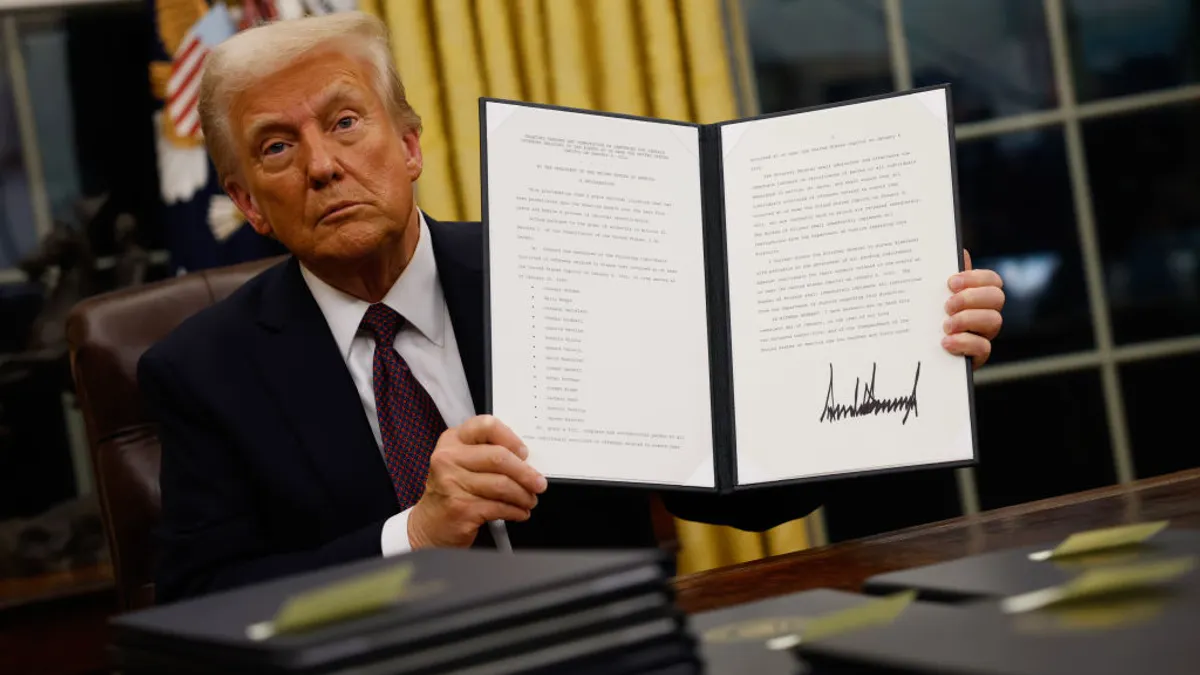
“For months leading up to the 2024 presidential election, President Trump made clear his disdain for ‘DEI,’ a term he used pejoratively but never defined, associating it with political ideologies he disfavored,” the lawsuit reads.
The president’s “anti-DEI”-related directives were not simply “a change in presidential priorities — a normal occurrence when presidential administrations change,” per the lawsuit. “Rather, they were targeted actions intended to punish perceived political enemies, as well as to eliminate from the federal workforce women, people of color, and those, like Plaintiffs, who advocated for or were perceived as advocating for protected racial or gender groups.”
Similarly, the EOs and directives violated Title VII, the lawsuit alleged, because they had “an unlawful disparate impact on women and non-binary employees, and/or people of color.”
The plaintiffs seek reinstatement, back pay, lost benefits and compensatory damages, among other relief, and demand a jury trial.