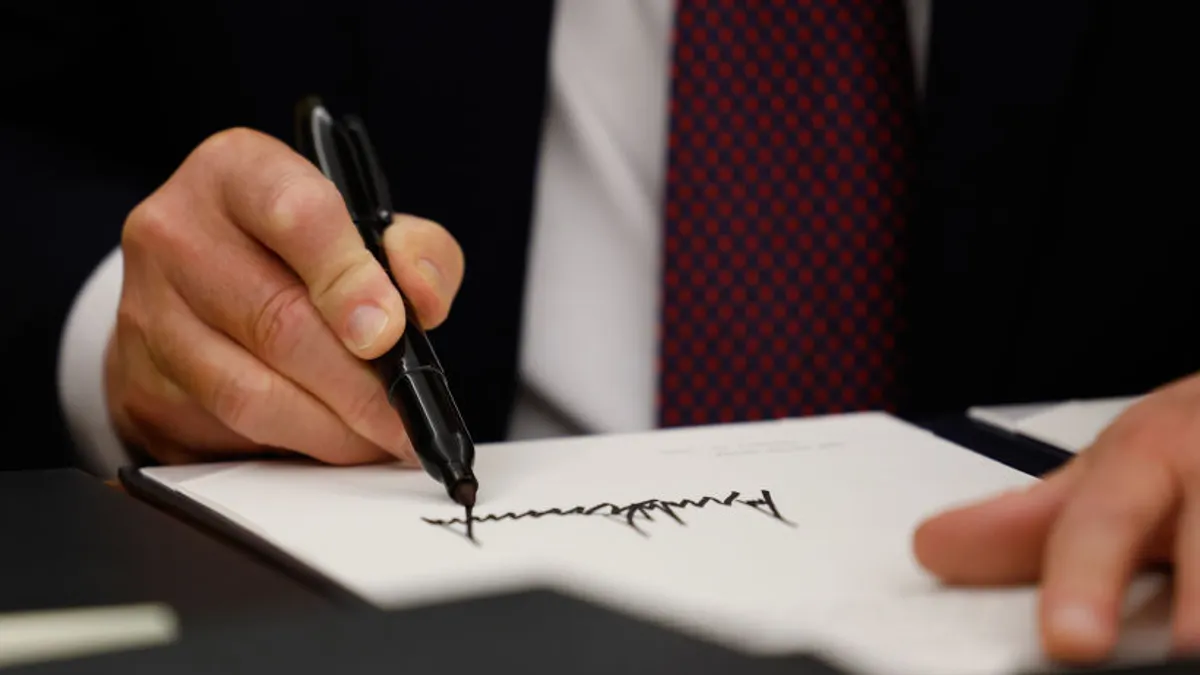
One year into President Donald Trump’s second term, his diversity, equity and inclusion agenda continues to take shape.
The shifts started on Inauguration Day: Trump rescinded a Biden-era mandate that every agency create an equity team; the president also moved to slash DEI programs at government entities and federal contractors. Consideration of federal job candidates’ commitment to gender equity and an expansive, federal acknowledgment of gender identity were also scrapped that day.
Those early moves signaled a position that would reach far beyond that of the executive orders. “Trump's anti-DEI orders not only gave a green light to discrimination across the economy,” Noreen Farrell, executive director of Equal Rights Advocates, told HR Dive via email: “They made this discrimination official government policy.”
Since then, the chilling effect has trickled into private-sector talent strategy.
Looking back: DEI throughout 2025
Some employers, like Apple, resisted the urge to roll back DEI. Costco similarly maintained its stance — drawing the ire of 19 attorneys general. Starbucks also remains in litigation over challenges to its DEI policies.
But overall, major players like Morgan Stanley and Capital One shied away from DEI, and companies like Accenture explicitly cited Trump’s EOs as their reason for backing away from DEI.
Executive orders and lawsuits — particularly an apparent rise in reverse discrimination claims— weren’t the only indication that the cultural tide was shifting.
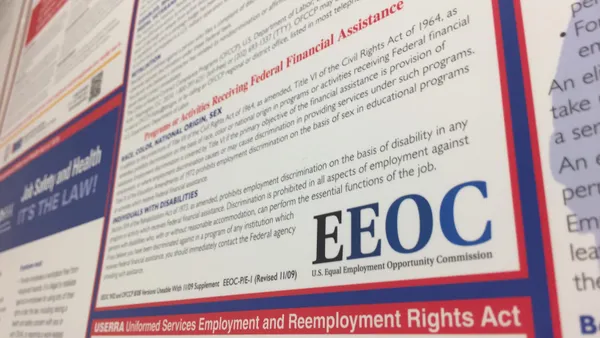
The U.S. Equal Employment Opportunity Commission has also been busy over the past year implementing Trump’s initiatives. The agency moved away from both disparate-impact enforcement and earlier guidance on protections for LGBTQ+ workers.
Many of the EEOC’s choices made under this administration — especially its failure to pursue claims transgender discrimination — “completely perverted the EEOC's mission,” Farrell said. “Instead of being a shield for workers facing discrimination, the EEOC has become a weapon against law-abiding employers trying to create inclusive workplaces.”
Moreover, Farrell said, “Chair [Andrea] Lucas is creating confusion and fear, causing employers to abandon their equity programs. The result? HR professionals are caught in the middle while the workers who actually face discrimination have been left with no recourse.”
Looking ahead: What could 2026 hold?
The effects of Trump’s policies and related actions on private-sector DEI are easy to see, according to Farrell.
Take women in the workforce, for example: “With wages already falling and women exiting the workforce in record numbers, stripping away workplace protections threatens to roll back decades of progress for women in the workplace,” Farrell said.
Moves such as these push paid family leave and affordable childcare further out of reach, Farrell said, noting that Trump’s administration recently froze childcare funding in five states.
The impact of a sitting president directing abandonment of policy that furthers civil rights laws “has been immediate and devastating on both workplace culture and longstanding practices,” said Farrell.
“When the federal government treats diversity and inclusion as bad words,” she said, “it encourages employers to abandon programs that create equal opportunities for workers and that affirmatively address harassment and bias in the workplace.”
In light of this stance, stakeholders have encouraged HR professionals to review their DEI initiatives for compliance with federal law. In an op-ed for HR Dive, for example, Jonathan Segal, partner with Duane Morris, said these changes amount to a clarion call for employers to review their DEI practices — but not to abandon them.