Dive Brief:
- The U.S. Senate voted 53-43 Thursday to confirm James Murphy and Scott Mayer as members of the National Labor Relations Board as part of a broader package of federal agency nominees.
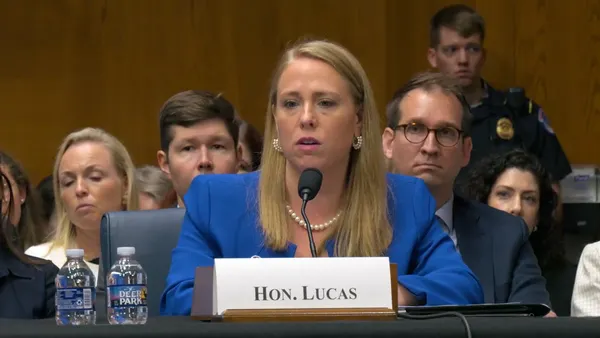
- The vote restores NLRB’s quorum, which the board lost following President Donald Trump’s controversial firing of Democrat Gwynne Wilcox. Murphy is a former career NLRB attorney who served at the agency for nearly 50 years prior to retiring in 2021, he told the Senate during his October confirmation hearing. Mayer is the former chief labor counsel at Boeing.
- The Senate also voted to confirm Crystal Carey as the board’s general counsel. Despite the news, NLRB’s regulatory activity may remain frozen as federal courts decide the trajectory of labor law in the intermediate term, Alexander MacDonald, shareholder at Littler Mendelson, wrote in an analysis.
Dive Insight:
Since Trump’s inauguration last January, NLRB has found itself at the center of a battle over its independence and its authority to enforce labor standards.
Wilcox’s firing, for example, formed part of a broader challenge of constraints on executive power. The former member of the board fought her dismissal in court, seeking — and temporarily succeeding in getting — reinstatement. But the Supreme Court upheld an order pausing Wilcox’s return and took up a separate case, Trump v. Slaughter, to decide whether Trump could fire Wilcox and similar federal officials at will. At oral arguments earlier this month, the court seemed likely to hold in Trump’s favor.
Separately, the state legislatures of California and New York sought to grant state labor regulators more power to fill in for NLRB when its lack of quorum left it unable to fulfill certain functions. The board challenged both efforts. A federal judge paused enforcement of New York’s law, and litigation in both cases, NLRB v. State New York and NLRB v. State of California, remains ongoing.
The agency did continue some work during this time, including rescinding Biden-era enforcement documents on subjects such as employer surveillance, the use of artificial intelligence tools and noncompete agreements.