

“Sociable” is the latest commentary on important social media developments and trends from industry expert Andrew Hutchinson of Social Media Today.
LinkedIn is the latest social media platform to give users a means to flag artificial intelligence-generated content. The platform is testing a new option that will let members report likely “AI slop” in-stream.
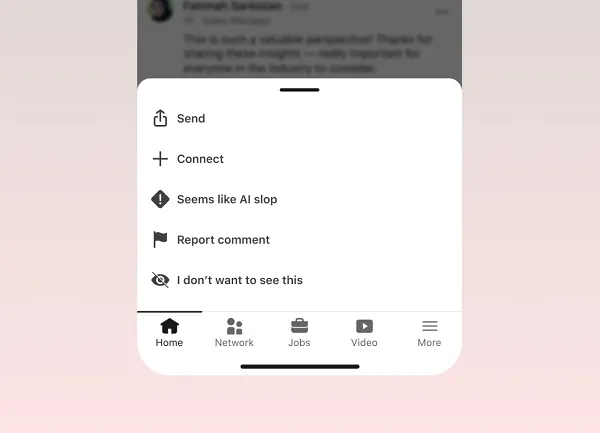
As shown in this image, which was shared by LinkedIn Chief Product Officer Hari Srinivasan, users can now report any comments that “seems like AI slop” by tapping the three dots menu at the top right of the display.
As explained by Srinivasan: “We are ramping the ability for members to tell us if they believe a post or comment seems like AI slop. Slop is hard to define and the definition changes; this lets us tune our models and make better feeds.”
In addition, Srinivasan said LinkedIn is improving its detection of AI slop and “generally low quality” content, and the indicators from reported posts will help refine the platform’s classification systems.
LinkedIn is planning to alert users when their posts have been reported as slop.“For anyone who shares content, we will test a way to privately flag, in your analytics dashboard, when members feel your post may have come off as inauthentic or heavy use of AI,” Srinivasan said.
The aim with this is to help identify when AI is being overused, Srinivasan said, adding that people who use AI tools to refine their thoughts should be able to continue to do so.
“We want members to get feedback from real humans on what sounds authentic — not just have an AI detector review it and get it wrong,” Srinivasan said.
It’s another way for LinkedIn to combat the rise in automated comments, which threatens to undermine trust in platform engagement. At the same time, this also runs counter to LinkedIn’s own push to integrate more generative AI elements, such as those that assist with job ads, job applications, posts and articles.
Basically, every element of the LinkedIn process now appears to incorporate some form of AI assistant. Whether intentional or not, this also enables LinkedIn users to automate their in-app activity and use AI outputs to make themselves sound smarter.
Though Srinivasan also flagged a shift in approach on this front within at least one element.
“We asked ourselves why do people post with AI anyway?,” he said. “The answer is LinkedIn isn’t a one-word kind of place and they feel more confident running their posts through AI. We’re taking this learning, removing the ‘enhance your post’ feature you see when you write a post or message & replacing with a feature that proofreads your words, but does not change your voice.”
This is more than just a tacit acknowledgment that LinkedIn’s AI tools could be detrimental to in-app engagement. LinkedIn is actually removing an AI feature that can be used to generate in-stream content.
It’s a significant step, especially considering the billions of dollars LinkedIn’s parent company Microsoft has invested into AI development.
Yet, as with many platforms, LinkedIn is recognizing that these types of tools enable too much automation and essentially facilitate bot-like behavior at a massive scale.
Indeed, this could arguably be an even bigger concern on LinkedIn than other social apps. That’s because LinkedIn is where users go to make professional connections, based on knowledge, insight and interest. If LinkedIn users are faking this with AI tools, that could devalue its entire network, with users unable to trust what they’re reading.
In this sense, the AI push also runs counter LinkedIn’s other efforts to ensure more trust. These include features such as member verification, which enables LinkedIn users to confirm that they are real humans through a third-party confirmation process. Over 100 million LinkedIn users have verified their identity thus far, yet that trust signal may not mean much if AI tools enable those same members to generate the content they share in the app.
LinkedIn’s update is recognition of this, making LinkedIn the latest platform to acknowledge that AI tools may not actually be great for social apps, which are fundamentally built on human connection.
All apps may eventually have to build in similar AI reporting options, with Pinterest, Snapchat, TikTok, Reddit and X each taking steps to slow the spread of AI-generated posts.
At the same time, these companies have also invested a lot into AI tools, and it will be a difficult balancing act for platforms to both facilitate AI creation while also limiting its potential harm.
Does that mean that all platforms will eventually scale back their AI options? That does seem likely as the capacity to produce fake, misleading material increases, enabling all-new forms of inauthentic activity.