Dive Brief:
- Operators of an Oklahoma medical clinic agreed Thursday to settle claims brought by the U.S Equal Employment Opportunity Commission that the clinic failed to accommodate a medical assistant with a high-risk pregnancy, forced her to take unpaid leave and fired her when she said she could not return to work without an accommodation.
- EEOC alleged that Urologic Specialists of Oklahoma, Inc. refused proposed accommodations including allowing the employee to sit, take short breaks or work part-time. Instead, an HR director placed the assistant on unpaid leave. Roughly one month after giving birth, the employee asked for a space and breaks to pump breast milk in order to return to work, but the director said such breaks could not be guaranteed. The clinic terminated the employee days later.
- The commission alleged violations of the Pregnant Workers Fairness Act and the Americans with Disabilities Act. Per the terms of its consent decree with EEOC, the employer agreed to pay $90,000 and furnish other relief, but it did not admit committing any alleged violations. Urologic Specialists of Oklahoma said in an email that it denied wrongdoing and resolved the matter to avoid prolonged litigation.
Dive Insight:
EEOC’s complaint is notable in its discussion of the PWFA’s requirements and the employer’s alleged failure to meet them.
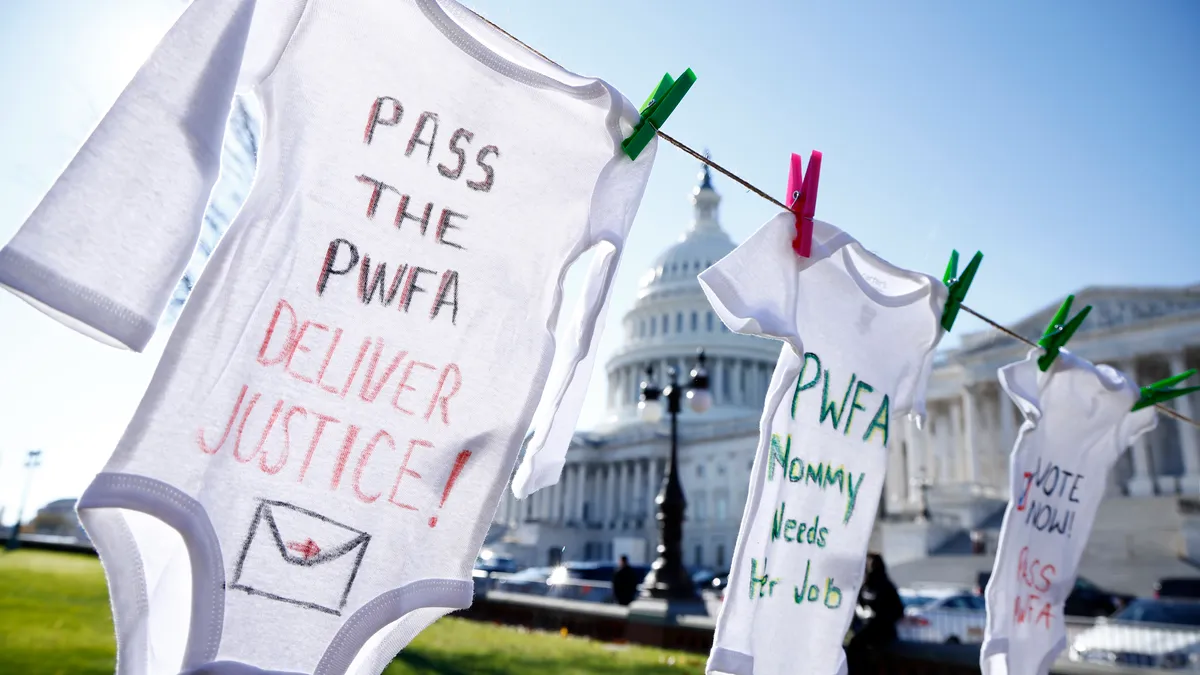
Under the PWFA, covered employers must provide reasonable accommodations to employees with known limitations related to pregnancy, childbirth or similar medical conditions. The law notably prohibits employers from requiring an employee to take leave, paid or unpaid, if another reasonable accommodation can be provided.
The law took effect in June 2023 between the plaintiff’s several accommodation requests. At one point during her correspondence with the clinic’s HR director, the employee claimed she asked the director whether he was aware of the PWFA’s accommodation requirement. The director allegedly said that he “knew nothing” about the law and that he would instead “just document that [the employee] was unable to complete her duties.”
EEOC’s consent decree directed Urologic Specialists of Oklahoma to engage or designate appropriate HR personnel for compliance with pregnancy-related employment laws and regulations, among other requirements.
“The PWFA’s requirements are simple and fair,” Joshua Stockton, lead EEOC trial attorney, said in an agency press release. “The policies and procedures required by this decree are a model that all employers should follow to ensure that pregnant women are never forced to choose between their jobs and their health and safety.”
The lawsuit had been part of a broader wave of pregnancy discrimination lawsuits filed by EEOC in 2024, many of them alleging failure to accommodate in violation of the PWFA. Though federal courts have since struck down portions of the agency’s Biden-era rule implementing the law, EEOC officials said Thursday that the commission would “vigorously” protect pregnant workers.
The PWFA and ADA are not the only laws that may factor into pregnancy-discrimination lawsuits. For instance, last week also saw a lawsuit against Google that incorporated alleged violations of the Family and Medical Leave Act.
Editor’s note: This story has been updated with a comment from Urologic Specialists of Oklahoma.