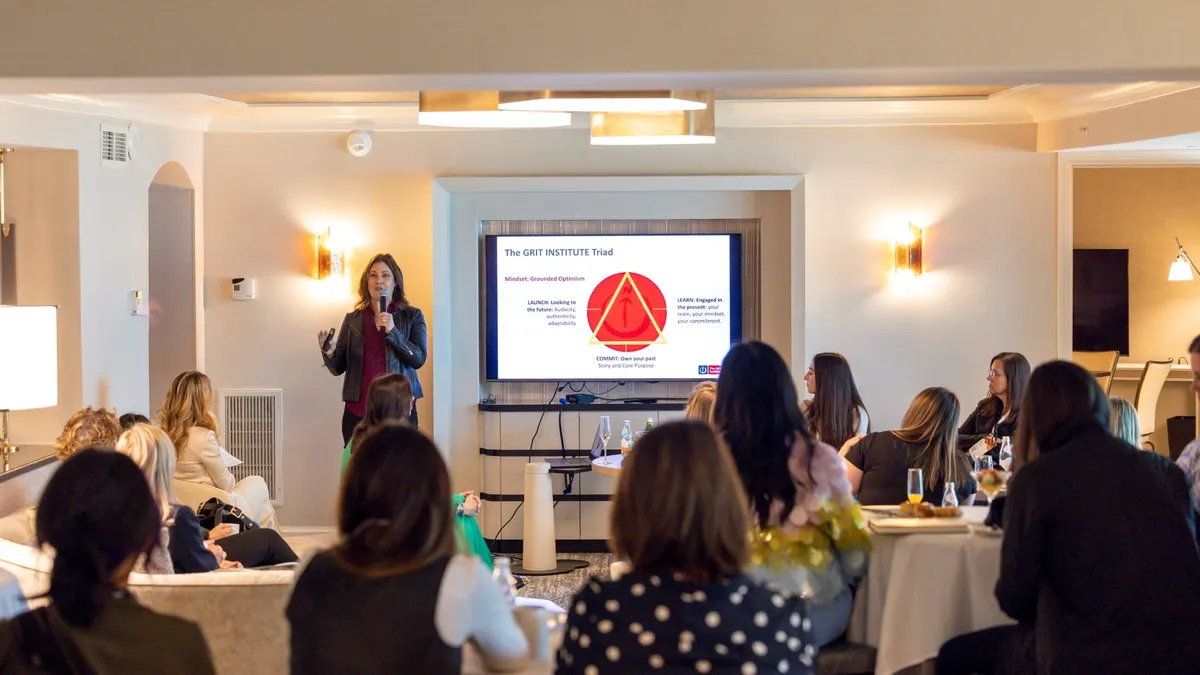

Leading a combat helicopter company and leading a corporate team may come with vastly different stakes—but for Shannon Huffman Polson, the core principles of effective leadership remain the same. One of the first women to fly the Apache in the U.S. Army, Polson led platoons and a flight company on three continents before earning her MBA at the Tuck School of Business at Dartmouth and managing teams at Microsoft. Today, as the founder of The Grit Institute and a lecturer for Tuck Executive Education, she teaches leaders how to build resilience, align to purpose and lead with authenticity during times of profound change.
In this Q&A, Polson shares insights that HR professionals can take directly back to their organizations—helping leaders reconnect to meaning, strengthen engagement and guide their teams through uncertainty with clarity and confidence.
1. In your Leading with Purpose session, you guide participants to “own their story.” Why is that such a powerful starting point for leadership?
We often assume that owning our story is something that happens naturally, simply because we’ve lived it. But the reality is that most people have never taken the time to do the deep internal work that allows them to really understand the experiences that shaped them.
When I teach in Tuck’s Leadership and Strategic Impact program, we use what I call the journey line exercise. We look at pivotal events—positive and negative—and identify what we learned from them. Then we query those events for the values that emerge: Which values do I want to carry forward? Which ones do I want to reframe or leave behind?
When people take the time to do this work, entire fields of opportunity open up. They rediscover strengths they didn’t remember they had. They see new pathways for contributing their best selves. This is why it’s such a powerful foundation for leadership.
2. Why does purpose-driven leadership matter so much today, especially at a time when employee engagement is at historic lows?
The data is unequivocal: purpose is the foundation for grit and resilience and it’s tightly connected to performance, well-being and engagement.
Employees who are connected to their purpose perform better, stay longer and are more engaged. They also have better markers of physical and mental health—everything from cardiac health to lower stress indicators. At a time when engagement is at all-time lows, this is especially important.
For leaders, doing the deep work around purpose is something we can’t afford not to do. The research even shows connections between purpose alignment and stronger organizational performance, including bottom-line impact. Purpose supports resilience, engagement and ultimately the ability to bring one’s best self to work.
3. For leaders who feel stuck or misaligned in their careers, what’s the first step to getting unstuck?
When someone feels misaligned, confused or overwhelmed by change, the most important thing is to go back to the basics. I teach the Grit Triad—a framework with three phases: Commit, Learn and Launch. When things are chaotic or uncertain, we always return to the Commit phase.
Commit is the deep internal work. It involves going back to your own story and asking: Where have I drawn strength before? What values emerged from these experiences?
After that, we explore the different paths to meaning in your life and work. Where do you find meaning? When leaders take the time to step back and return to the commit phase, the clarity that emerges is often transformative.
4. You’ve written The Grit Factor, founded The Grit Institute and host The Grit Factor Podcast. What does grit mean to you—not just as a concept but as a daily practice?
Many people think of grit as simply gutting it out. And yes, perseverance is a part of it. But I see grit as something much more holistic.
I define grit as dogged determination in the face of difficult circumstances. As a daily practice, grit means reconnecting with your values and purpose. It also requires boundaries. Grit is essential to development and success, but it’s not a sustainable operating mode. You have to rest, recharge and return stronger so you can give your best to the mission at hand.
How can HR leaders help managers and executives bring purpose and grit into their everyday leadership practices?
HR plays a critical role here. First, organizations need to create space for leaders to do deep internal work. Professional development programs can help leaders reconnect with purpose, but HR can reinforce that learning through ongoing reflection, coaching and values-based conversations.
Second, HR can model and support the behaviors that build grit: encouraging grounded optimism, normalizing learning from failure and helping leaders develop the skills of deep engagement—active listening, building trust and caring for their people.
Finally, HR can help leaders set the conditions that make grit sustainable: healthy boundaries, time for rest and renewal and clarity around what matters most. When HR champions these practices, leaders are better equipped to build resilient, purpose-aligned teams who can weather change and continue to thrive.