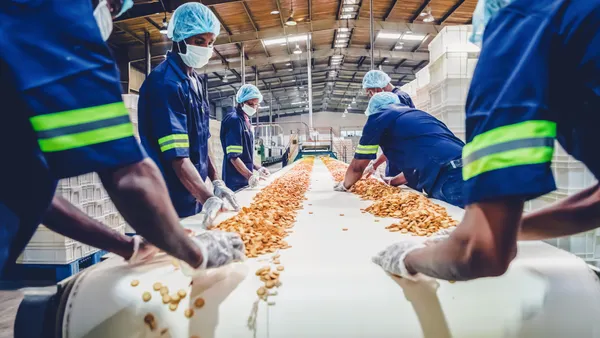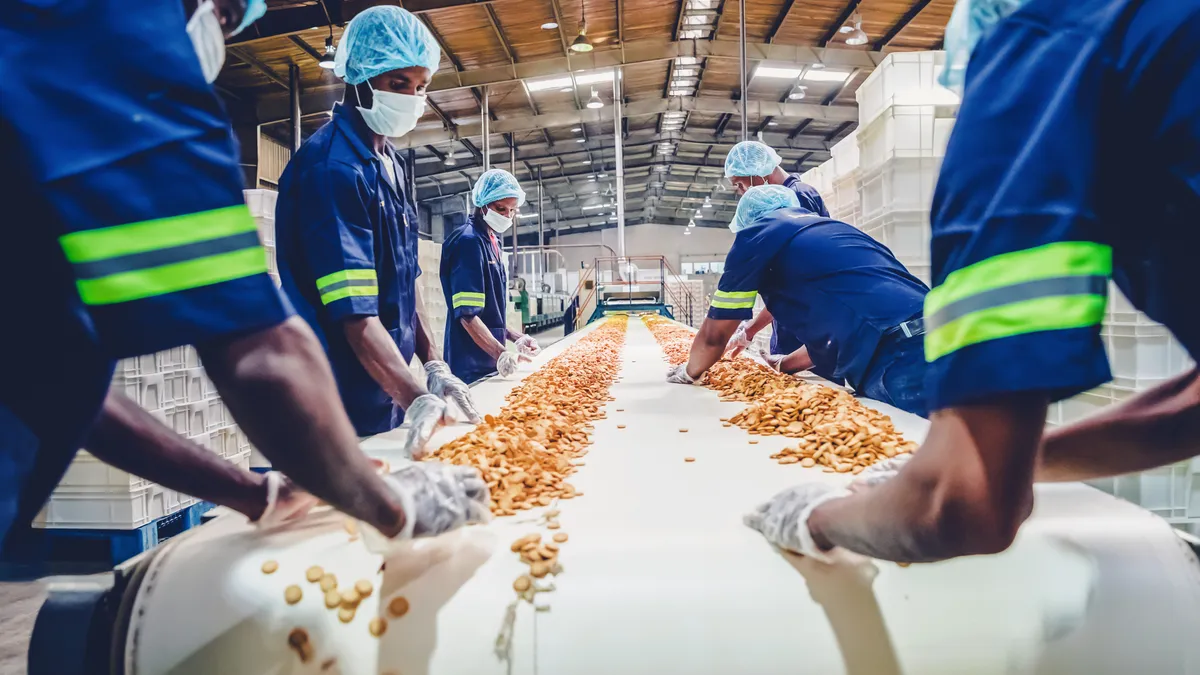

To more effectively communicate with workers who speak little to no English, a growing number of U.S. manufacturers are leveraging translation technologies driven by artificial intelligence. They are also using real-time translation tools to improve safety and compliance with regulatory standards.
Imogen O’Connor, a consultant at Streamliners Management Consulting, said one of her manufacturing clients — a Pennsylvania foundry that employs 1,000 people — is starting to use AI-driven technology to more efficiently translate standard operating procedures, or SOPs, and safety signs into other languages. On-site training has been an issue because the trainees and trainers do not speak the same language, she said.
“There’s only so much you can do with pointing at machines,” O’Connor said.
The client, which O’Connor declined to disclose for privacy reasons, is also starting to implement AI to translate its monthly town hall meetings, which are currently conducted in English. Workers will get out their phones and use Google Translate to get snippets of what is happening, she said, but much of the information gets lost.
To address this, the company plans to roll out live captioning for when the plant manager speaks next month. Some of its supervisors are also starting to use smart earpieces to improve instant communications with workers, O’Connor said. This has been notably helpful for plant workers who speak Arabic.
“No one had asked them how they’re doing, how they’re feeling, what they need, because no one has the Arabic skills to be able to talk to them,” she said. “Now they’re being seen and heard.”
Worker morale and productivity
Language barriers on production floors can impact worker morale and productivity, as well as contribute to hidden operational costs. According to a survey from Relay, a maker of smart radios that offer real-time AI translation, businesses lose nearly $500,000 per year on average in unseen labor costs related to ad-hoc translation practices. This is often due to employees being repeatedly pulled away from their primary responsibilities to translate for their co-workers.
Manufacturers employ roughly 3.1 million foreign-born workers, representing about 20% of the industry, according to 2024 U.S. Census Bureau data. Roughly half of all foreign-born individuals over the age of five speak English “less than very well” in the United States.
Foreign-born workers play a vital role in reducing attrition and supporting operations as companies navigate workforce shortages, according to the Manufacturers Alliance. Employers are seeing stronger retention rates from them, in part, driven by investment in English-as-a-second-language programs.
Safety, compliance and development
Smartcat, an AI-driven translation platform used by Volvo, Mars, Stanley Black & Decker and others, found that manufacturers are primarily leveraging its technology for safety compliance, as well as learning and development. Beyond enhanced coordination on the production floor, ensuring corporate documents are uniform and legible in a number of languages is key from a supplier standpoint.
Companies today are often “stuck” in their traditional processes related to SOPs, safety protocols and technical manuals as they navigate increased changes in policy, regulations and economics, said Falk Gottlob, Smartcat’s chief product officer. By automating these processes, key supplier and worker documents can be updated continuously, alleviating potential bottlenecks created by legacy translation.
With traditional document translation, typically the content is created in one system, then someone sends it to another person for collaboration, who then uses a different system, and so on, Gottlob said. Often, something gets lost in the process.
“There’s a legacy workflow that is fundamentally broken,” he said. Through AI-driven translation, Gottlob said companies can “generate content natively right away” and can take steps out of the analog process.
As AI powered by large language models becomes more accessible to companies, the technology is also reshaping the translation and interpreting industry. Before the advent of ChatGPT and other LLM tools, translators used neural machine translation for predictable, low-risk content, or drafting preliminary texts, according to the American Translators Association. However, the technology can introduce “inaccuracies, inconsistencies, and misinterpretations” that require expert human intervention to discern and correct.
As the public more broadly adopts digital-first approaches, the association’s stance is that qualified, technically proficient language professionals should lead the way in shaping how AI is integrated. Otherwise, the association said, potential inaccuracies can yield major repercussions.
Nishchay Selot, a senior consultant at Streamliners, said he recently used the generative AI tool Perplexity to build a dedicated guide to ensure an Indiana-based snack food manufacturer is complying with standards from the Occupational Safety and Health Administration.
The company, which Selot declined to name due to privacy concerns, is on track to more than double its revenue to $500 million by 2030. He said the company sought help to ensure its factory could still meet OSHA standards as it scales production.
To address this, Selot crafted a large prompt containing factory specifications, including number of aisles, racks, production lines, people and even bathrooms. He fed the data along with different OSHA files into Perplexity, and out came a dedicated manual that could then be translated into other languages with a few keystrokes.
That language flexibility allowed supervisors to distribute the same manual to shop floor operators who may speak Spanish or a French-based Creole, Selot said. One of the benefits of Perplexity over Google Translate is that there are certain nuances that make for a better, more accurate translation, he added.
“We had this validated through some of the native speakers over there as well, and they found this very useful,” Selot said.
In cases where exact translation is imperative, companies should use backup experts or services, O’Connor said. But when immediate communication is necessary on the shop floor, the general consensus from supervisors is that having workers who speak little to no English understand 80% of the message is better than none at all, she said.
“Just having someone scan over and say, ‘yep, this all makes sense’ is way better,” she added.