Jennifer Serafyn, Dawn Solowey and Sam Schwartz-Fenwick are labor and employment law attorneys at Seyfarth. Serafyn is former chief of the civil rights unit at the U.S. Attorney’s Office for the District of Massachusetts. Solowey and Schwartz-Fenwick are co-chairs of the firm’s cultural flashpoints task force.
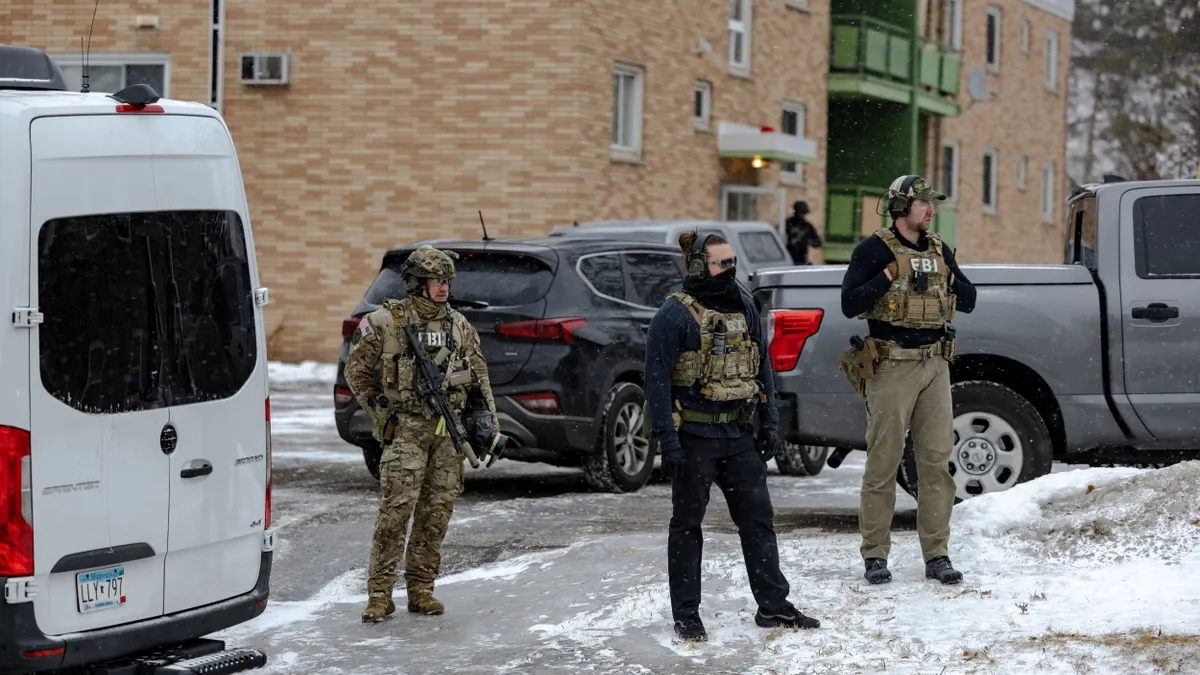
The scene in Minneapolis has become increasingly volatile. On Jan. 7, an Immigration and Customs Enforcement officer fatally shot 37-year-old Renee Good during enforcement operations

Protests erupted across the city and on Jan. 15, President Donald Trump threatened to invoke the Insurrection Act, which allows the president to deploy armed forces to carry out law enforcement functions, such as making arrests and conducting searches. The last time this act was invoked was in 1992 following riots in Los Angeles after the Rodney King verdict.
While Trump’s recent comments were aimed at Minneapolis, employers across the country should prepare now. Invoking the Insurrection Act will create unique legal and practical challenges—not just in the deployment zone, but in workplaces nationwide as this divisive issue becomes a cultural flashpoint.
Challenge 1: Employees can’t (or won’t) get to work
If Trump invokes the Insurrection Act, employers should anticipate mandatory closures, city-imposed curfews, restricted employee access to worksites and operational paralysis—even if the business is outside the epicenter of unrest. Even if the president does not use the Insurrection Act, continued deployment of the National Guard and ensuing protests could cause similar disruptions.

The last time the act was invoked, many employees could not physically travel to workplaces because of transportation shutdowns, blocked streets, checkpoints and unsafe conditions.
During times of civil unrest, employees also may be afraid to leave their homes. Employers should treat these situations carefully because what may be mere absenteeism under normal circumstances could rise to the level of legitimate safety concerns or political opposition to federal action. The distinction matters legally but may be challenging if not impossible to draw cleanly.

Employees also may claim that not honoring a requested work from home accommodation request violates Title VII of the Civil Rights Act of 1964 given the unique risk they face as a person of a visible minority or religion. Indeed, in Minnesota the Muslim Somali community and the Latino community are both facing very high levels of scrutiny from ICE.
The Americans with Disabilities Act may similarly come into play if employees develop anxiety, PTSD or other conditions from witnessing violence or traumatic incidents.
These issues will render attendance policies particularly fraught, requiring employers to grapple with several thorny questions: How do you distinguish legitimate safety concerns from political protest? What if only certain employees – those living in affected neighborhoods, for example – face barriers, creating potential disparate impact concerns? Can you require documentation of safety concerns? What kind? What if an employee’s entire commute route is affected by protests or federal operations, but the workplace itself is secure? There are no one-size fits all answers to these questions, but it is important for employers to assess these legal and practical considerations now to avoid potential liability down the road.
Challenge 2: Political tensions explode at work
The political controversy over deploying federal troops to American cities has and will inevitably continue to spill into the workplace; the question is how employers manage it.
Managing challenging flashpoint conversations
If the Insurrection Act is invoked, employers should expect discussions about federal immigration enforcement; the Insurrection Act and military deployment; specific violent incidents; and protests and civil disobedience. Each topic touches on identity and lived experience, and emotional intensity will be high.
When two employees have a heated exchange about Trump’s military deployment threat, when should a manager intervene? If a supervisor expresses strong views about protests, do power dynamics create hostile environment risk? Where does the employer draw limits as to profanity? How do you address disruption without appearing to take political sides?
These questions have no formulaic answers. They require case-by-case analysis with an understanding of the legal frameworks at play as well as consistency when disciplining employees.
Many employers will draw a bright line where workplace speech (or off-duty speech that implicates the workplace) veers into encouraging or celebrating violence.
Further, discussion that veers into discrimination is never acceptable. Statements about immigration or immigrant communities that insult others based on religion; national origin or race; or other protected classifications cannot be tolerated.
The protected characteristics intersection
Immigration enforcement debates often intersect with religion, national origin and race, and.employers that discipline an employee for political speech may risk proxy discrimination.
If an employer disciplines employees for anti-ICE speech but not pro-enforcement speech, and the former group is disproportionately Latino while the latter is disproportionately White, a pattern of discrimination may emerge. Because every situation is different, employers should consult with in-house or outside counsel in these situations.
When can employers intervene?
Employers can regulate workplace conduct. They can enforce policies requiring civility and respect. They can address speech that disrupts operations during work time. They can – and must -- prohibit discrimination and harassment.
What employers cannot do is discriminate based on a political viewpoint or penalize speech protected by state political activity laws or the National Labor Relations Act. Several states, including California, New York and Illinois, provide significant protection for employees’ off-duty and political activities and, in some cases, political expression at work.
The NLRA protects employees’ rights to engage in “protected concerted activity” about terms and conditions of employment, even in non-unionized workplaces.
And union demands regarding how an employer responds to ICE presence could give rise to a duty to bargain. Likewise, a non-union employee wearing an “ICE Out of Minneapolis” button, for example, might also be engaging in protected activity if this can be connected to workplace concerns.
Before disciplining employees for political expression related to these issues, employers should consult counsel. What appears to be purely political speech may have protection under the NLRA if there's a nexus to working conditions.
What employers should do now
1. Develop specific emergency playbooks
Standard emergency action plans may be insufficient for the current situation.
Prepare specific protocols for: communication during rapid developments; determining when to close operations; facilitating employee travel through checkpoints; and switching to remote operations where applicable.
2. Review and modify attendance policies immediately
Consider suspending attendance systems during emergency periods. Ensure your attendance policy explicitly excludes ADA, FMLA and state sick leave absences from any discipline. Document all policy modifications in writing and communicate them clearly to all employees. Plan for large-scale absenteeism and lost income for hourly workers during prolonged disruptions.
For those employees who may be deploying with the National Guard, employers should always be mindful of their Uniformed Services Employment and Reemployment Rights Act obligations and must understand reemployment rights and benefits continuation requirements.
3. Train managers on political speech and off-duty conduct boundaries
Managers must understand NLRA basics: Speech about workplace conditions may be protected even when it seems political. Train on relevant state political activity and off-duty conduct protection laws. Emphasize a “conduct not content” approach; address disruption, volume and unprofessionalism — not a political viewpoint. Make clear that managers should not express personal political views to subordinates and must not favor or disfavor employees based on political alignment.
4. Prepare documentation for employee travel
Develop template letters and employee identification cards that document work hours, location and “essential” status, if relevant. Employees may need these to navigate curfews or checkpoints. Have them ready to distribute quickly if deployment occurs.
5. Handle accommodation requests consistently
Employees may request time off to participate in protests; flexible schedules due to childcare disruptions; remote work due to safety concerns; or mental health support for witnessing violence. Evaluate each request under existing leave policies first. Consider ADA obligations if mental health is involved. Document all requests and responses carefully. Apply the same standards regardless of which “side” of the political issue the employee appears to support.
6. Keep it boring, strategically
Don’t litigate the political flashpoint itself in your workplace. When addressing employee conduct, focus on the behavior – disruption to operations, time spent on non-work topics, hostile interactions – not the political opinion expressed. Frame decisions around business necessity and workplace professionalism, not political agreement or disagreement. Strip inflammatory political content from your documentation and focus on neutral, observable facts.
7. Communicate clearly and neutrally
Acknowledge the situation without taking a political stance. Messages to employees might include: recognition that current events may affect the community differently; available accommodations (e.g., flexible schedules, remote work, leave options); expectations for respectful workplace interactions; and resources for employees experiencing stress. Avoid language that appears to endorse or condemn federal actions.
8. Document everything
Track attendance issues and stated reasons. Record operational disruptions and business impact. Preserve communications about schedule changes and policy modifications. Maintain decision-making logs showing consistent application of policies regardless of employees’ apparent political views. This documentation may be critical for potential Worker Adjustment and Retraining Notification Act analysis if extended closures become necessary and for defending against discrimination or retaliation claims.
9. Consult employment counsel early
These situations evolve rapidly. The legal landscape around protected political speech is unsettled, with the National Labor Relations Board continuing to clarify the scope of protected activity. Multiple employment laws intersect in complex ways. Counsel experienced with cultural flashpoints can help navigate these issues before they escalate into litigation. Proactive guidance is significantly less expensive than defending claims after the fact.
Conclusion
Federal military deployment under the Insurrection Act represents a new category of workplace challenge, one that combines operational disruption with intense cultural flashpoint dynamics. Unlike natural disasters, where employees generally unite in response, this scenario divides workforces along political lines while simultaneously creating attendance and safety complications.
The employers who successfully navigate this terrain will be those who prepare proactively, communicate clearly and neutrally, maintain legal compliance across multiple intersecting statutes and focus relentlessly on workplace conduct rather than political viewpoints. A strategic approach enables employers to minimize risk of not only adverse legal outcomes but also negative impacts on workforce morale, business continuity and organizational reputation during an unprecedented challenge.