The adoption of artificial intelligence is reshaping the workplace, and the HR department is no exception to that change.
This report will discuss benefits and challenges related to AI tool use, including:
What HR should do before deploying AI notetakers
How teams are experimenting with AI for setting compensation
Why HR departments run with AI agents will still require humans
This report does not exhaust the ins and outs of AI in HR, but it highlights the most pressing issues and evolving trends. We hope you enjoy this in-depth look.
HR must set boundaries as it embraces AI notetakers, experts caution
Practitioners are increasingly responsible for vetting such tools before they are deployed in a workplace or recruitment setting, SHRM CHRO Jim Link told HR Dive.
By: Ryan Golden• Published Sept. 14, 2026
Sitting in the background of modern office meetings and job candidate interviews is an increasingly familiar presence: the electronic notetaker.
Artificial intelligence has powered a recording software boom as transcription services and similar tools aim to summarize hours of human-to-human discussion. But the use of these systems by HR teams has raised red flags among practitioners and legal counsel.
An emerging issue is that some platforms may not even alert participants that a recording is in progress or that it will be transcribed or used for future purposes, said Brian McGinnis, partner at Barnes & Thornburg. This is meant to reduce friction and is even marketed as an attractive feature, but it could be a legally dubious one depending on where participants are located.
Various states require all-party consent to recording of conversations, such as California, Florida and Illinois. And given that modern virtual calls can involve participants from any state or country, HR teams will need to take note and manually obtain others’ consent if the notetaker or recording tool doesn’t automatically provide an opt-out.
There’s also the matter of context. McGinnis said he is seeing HR teams most often use automated notetakers in the recruiting space, which is potentially problematic given an emergent trend of state and local laws regulating the use of AI in employment decisions. For this reason, a video call with a potential hire that features AI-based recording and transcription is “considered more high risk than your typical Zoom meeting,” McGinnis added.
Separately, a handful of states have workplace monitoring laws that may come into play, said Adam Solomon, partner at Hunton Andrews Kurth, and these laws often specify how employers must provide advance notice to employees about recording technologies. And there are even more categories of laws that could be applicable, Solomon noted, including social media privacy laws and intrusion on seclusion torts, which not all states recognize.
“That’s the hodgepodge we tend to think about,” Solomon said. “While there’s a lot of different restrictions, the bottom line is that reading these laws rather permissibly basically creates an opt-out regime.”
AI notetakers present a governance issue in much the same way as any workplace tool, said SHRM CHRO Jim Link, so it’s incumbent upon HR teams to know the ins and outs of their notetakers before deploying them. Recordings also may capture protected or sensitive information, creating even further compliance exposure.
“By golly, I would want to have all of my ducks in a row if I was using this in this current landscape,” Link said.
Is full disclosure the simple answer?
As a baseline matter, SHRM encourages HR teams to disclose the use of AI tools, Link said. If any sort of recording or transcription is in progress, employers should seek the okay of all present parties before proceeding.
“Transparency is absolutely part of the employee experience,” he continued. “The more transparent and descriptive they are of the technologies and tools they’re using and the knowledge and data that is used or gained, the better.”
Link also noted the importance of ensuring that human beings make HR decisions rather than AI or any other tool. AI can help HR teams make good decisions, but the final call should ultimately lie with a human decision-maker, he said.
From a compliance standpoint, employers may want to adopt a strategy of identifying the jurisdiction with the most stringent requirements for notetaking or recording tools and applying that standard broadly. This is an operationally easy approach, McGinnis said, but it also means that organizations will need to pay attention to new laws over time and adapt accordingly.
A trickier question concerns how recorded conversations are used once they are saved in an AI tool developer’s system.
While vendors generally follow principles such as deidentification, anonymization and aggregation in order to create less identifiable and sensitive datasets to train their models, each provider has its own specific process for doing so, McGinnis said. This is generally laid out in a tool’s service terms, and legal counsel may be able to assist employers in understanding what steps a vendor takes to comply with relevant privacy and data laws.
HR’s emerging role as a vetter of tech
Technology has always been one of many functions beneath HR’s very wide umbrella, but it is fast becoming a bigger priority in the age of AI.
Link said he receives at least two to three unsolicited messages per week from a person or vendor pitching a new AI capability or tool, many suggesting that their tools allow employers to make informed decisions to increase the likelihood of a successful hire. But even if AI is helpful, HR must ensure it vets specific tools thoroughly before deciding how to use them, if at all, he added.
“At the end of the day, if an employer can’t explain where candidate data comes from, how it’s protected and what becomes of that knowledge or information, then that tool is not ready for hiring use,” Link said. “Our preference is that employers own that data and control how it is used.”
Article top image credit: Carl Court via Getty Images
HR teams cautiously experiment with using AI to help set workers’ pay
The technology can augment the work of human compensation professionals, but a range of legal and privacy concerns are slowing adoption, sources told HR Dive.
By: Ryan Golden• Published April 9, 2026
Pay practices are quietly moving up the list of HR functions set to be affected by artificial intelligence.
Experimentation with AI in the area of pay, benefits and total rewards increased from 2025 into the early months of 2026, according to a February Korn Ferry survey of HR and total rewards professionals. However, the firm found that most organizations remain in the early stages of adoption, with 57% of respondents stating they had not even begun to experiment with AI in total rewards.
That’s reflective of the experiences of consultants like Gordon Frost, global rewards solution leader at Mercer, who told HR Dive that the use of AI to set pay has been slow due to concerns about risk. But it’s apparent that the tech has carved out a role in many organizations, he said, because it can augment the work of compensation professionals.
AI use in total rewards increased last year, but most have not begun experimenting
% of respondents to Korn Ferry's February 2025 and February 2026 Global Total Rewards Pulse Survey by current state of organizational maturity with respect to use of AI in total rewards processes
Setting pay involves synthesizing a number of data sources, both external and internal, and AI is being tasked with making that data faster to collect and easier to analyze in a more consistent manner. “We’re seeing people start to use it from that perspective,” Frost said.
So far at least, it’s generally not the case that employers are using large language models like OpenAI’s GPT or Anthropic’s Claude to assign specific dollar figures to a role or individual worker, Jamie Eisner, attorney at Offit Kurman, said in an email. Instead, she said, she more frequently sees employers deploy AI as a “system that shapes the data, assumptions and decision-making frameworks that ultimately influence pay outcomes.”
Employers also seek to make the tech part of a holistic, broader compensation strategy as they mull which factors they want to consider in setting pay, said Britney Torres, senior counsel at Littler Mendelson. There’s also hope that AI can improve consistency for pay practices across organizations, especially those with large workforces.
“Ultimately, improving the accuracy of your wage and compensation setting program is done to accurately reward the employee,” Torres said. “The draw of AI in this context is to improve the quality of that output.”
But it’s not something HR departments can adopt without doing some legwork. Frost said there’s a level of foundational work that has to happen before AI is integrated into any HR process, and a big part of that work is gathering all of the organization’s relevant data into one place — and ensuring that data is free of errors and unintended biases.
“That work has been going on for years and years, but it’s almost a foundational precursor to doing all of this stuff,” Frost said. A number of complexities can emerge, he added, especially when an organization has gone through several acquisitions of firms that employed different job titles or codes or had multiple employees doing similar jobs. “All of that needs to be cleaned up, simplified and aligned before you can use AI or do sophisticated data analysis.”
And that’s without getting into the nation’s increasingly complicated AI compliance picture.
Uncertain legal landscape presents an obstacle
Using AI to set pay could implicate several federal laws, including the Fair Labor Standards Act. Eisner said employers may violate the FLSA if their AI-influenced pay structures lead to employee misclassification, minimum wage violations or overtime pay errors.
AI systems trained on historical pay or performance data also may unintentionally replicate or amplify existing pay disparities, such as those that occur along gender or race lines, and this can create liabilities under federal equal employment opportunity laws, Eisner continued.
“Just knowing what the security parameters are and what the privacy guardrails are is super important.”
Gordon Frost
Global Rewards Solution Leader, Mercer
Several states, meanwhile, have passed laws restricting AI’s use in hiring, and some of these statutes contain provisions that could affect systems used in the pay context, Torres said.
For instance, California privacy regulations require certain employers to issue pre-use notice requirements informing consumers about their use of automated tools in areas such as compensation. Others specify that employers must conduct risk assessments of their tools or keep data pertaining to AI use.
States have been slower to adopt laws that specifically address AI’s role in setting wages, Torres added, though some proposals have been floated by local legislators. While it’s too early to predict which laws or frameworks will emerge first, Torres said, employers can identify certain “big-picture concepts” to help prepare for future requirements.
One key provision in several AI-related pieces of legislation concerns anti-bias assessment requirements. Torres explained that such clauses are meant to ensure that an automated tool makes determinations that are both free of discrimination as well as legitimately based on factors pertinent to the employee’s role.
Other parts of state AI laws can affect compensation strategy. Maryland’s AI law addresses the use of facial recognition tech during the hiring process, and laws of this sort may impose consent or use restrictions depending on how a tool functions, Eisner said.
“The key point is that AI does not shift legal responsibility away from the employer,” she added. “Employers remain accountable for wage outcomes, regardless of whether a human or an algorithm make the recommendation.”
Which inputs should be avoided?
Avoiding discriminatory AI outputs isn’t as simple as prompting a tool to ignore protected characteristics, Eisner said. Instead, employers have to be intentional about how an AI is governed, keeping in mind that the tech is only as good as the information an employer provides.
“Employers should clearly define what inputs are permissible and explicitly exclude inputs that may lead to biased outputs or pay disparities,” Eisner continued.
Even seemingly neutral factors — like an employee’s pay history, assumptions about an employee’s career path, location data and performance history — can skew results in ways that disadvantage certain groups, Eisner said. Employers also create risk by relying on “overly blunt” metrics, she added, such as keystrokes and mouse movement.
Employers must ask themselves what factors may be considered a proxy for bias, Torres said, emphasizing that pay determinations should be based on nondiscriminatory, nonretaliatory reasons. Performance can be a sensible way to approach this topic, but even there, HR has to be thoughtful about how performance is measured.
For instance, Torres noted that if performance is based on audio or visual surveillance data, that could implicate protected characteristics such as an employee’s national origin, race, ethnicity or disability.
“It’s not just about configuring the tool to comply with the law,” Torres said. “You also want to plan for that meaningful human oversight and regular anti-bias assessments to protect against discriminatory patterns that may develop as a proxy.”
Data security a ‘major’ consideration
Employers also may be wary of sharing sensitive HR data to AI tools. Mercer’s Frost said organizations are generally hesitant to begin using AI in the pay context unless they are certain that the tool is completely compliant with their organizational firewall and designed for private, internal use.
“That’s one reason why we’re not seeing widespread use of [AI in pay] yet,” Frost continued, adding that HR teams should know never to feed employees’ pay information into a publicly available AI model. “Just knowing what the security parameters are and what the privacy guardrails are is super important.”
It’s important for compensation professionals to ensure that the data they use is anonymized and to think through how legal privilege might apply to any decisions made based on AI’s contributions, Torres said. This is the case even if an AI’s recommendations are not used to implement a pay decision.
AI tools also draw from data sources beyond pay data alone, including for human resources information systems software that tracks employee data, performance, engagement and other indicators, Eisner said. Employers, she added, should be transparent with employees about the types of data used, how that data is used and why collection is necessary.
Any AI use is likely to involve the use of a vendor, and vendor relationships also present HR risks worth considering. This includes vendor handling of data and any associated contract language around data ownership and security safeguards, Eisner said.
“A guiding principle here should be data minimization: don’t collect or process data you don’t actually need because unnecessary data collection may create legal exposure without delivering corresponding value,” Eisner continued.
HR professionals should approve the output of AI platforms using their own knowledge and experience, sources told HR Dive.
Getty Images
HR must maintain human oversight
It’s key for HR professionals to review AI outputs and make the final determinations on all compensation decisions, Frost said. He noted the use of an AI tool is, in this respect, no different than using Microsoft Excel in that a human must approve the output of a given platform using their own knowledge and experience; “We’re not just completely giving it to AI and absolving ourselves of responsibility.”
This point reinforces the need for good governance procedures, Torres said, as it can be difficult even for humans overseeing an AI’s output to check for bias without knowing what to look for. Training can help, but on a systemic level, employers have to budget for and employ a range of measures such as audits and risk assessments to ensure they have a compliant pay process, she added.
Before an employer chooses to adopt AI in its compensation practices, Eisner said it might first articulate what it is trying to accomplish by introducing the tech, what data it will need to ensure successful implementation and what values it wishes to be reflected in its pay practices.
“AI should be treated as a decision-support tool, not as an autonomous decision-maker,” Eisner said.
Article top image credit: Stefano Guidi via Getty Images
Recruiters find people faster with AI — but confidence in candidates hasn’t followed
More than 2 in 3 recruiters told TestGorilla they spend an hour or more manually checking a candidate’s credentials.
By: Kathryn Moody• Published Oct. 16, 2026
Recruiters are finding candidates faster thanks to artificial intelligence tools, but that speed is not translating into candidate confidence, according to data sent to HR Dive by TestGorilla.
While 72% of the more than 1,400 U.S. talent professionals surveyed said AI made finding candidates quicker, a third of those who reported as much said they gained no confidence in the solidity of the candidates — and 18% said their confidence actually fell.
In order to ensure these candidates can do the job, recruiters “are making up the difference themselves, by hand,” per TestGorilla, an AI recruiting platform. But recruiters, per various surveys, are already struggling under an unprecedented number of applications.
More than 2 in 3 recruiters told TestGorilla they spend an hour or more manually checking a candidate’s credentials, while 30% said they spend two hours or more.
“Recruiters got a better search engine and a worse index in the same 12 months,” said Wouter Durville, CEO and co-founder of TestGorilla. “Every sourcing tool sells reach, and reach is close to free now. The expensive thing is a shortlist you can defend to a hiring manager, and most tools give recruiters no way to tell a checked claim from an unchecked one.”
Such is especially important in a time when applications per hire have tripled since 2021, according to an analysis released earlier this year by recruiting platform Ashby. Open roles tend to garner an average of 300 applications, Ashby said.
One upside of AI tool use for recruiters, however, has been more hands-on time with candidates, a report from the American Staffing Association said in June. Call time had increased to a record 286 minutes per week, reflecting where recruiters were putting time gains made by AI tool use.
“Doubling call time in two years is a significant finding, and it tells a compelling story about where AI adoption is actually paying off,” an ASA executive said at the time.
But amid the deluge of applicants, recruiters are also having to get more creative in sourcing candidates they can trust — including by recruiting outside of work, like at restaurants and grocery stores, per a Zety report from April.
Article top image credit: Justin Sullivan / Staff via Getty Images
HR leaders may be able to use AI to improve employee wellness
Nearly half of workers have been reluctant to use artificial intelligence, but a study from Gartner found the technology may be useful in identifying burnout.
By: Lara Ewen• Published Oct. 14, 2026
Artificial intelligence adoption may not be making employees feel positively about themselves, with many workers reporting that while they think AI has had a positive impact on their company, they’re not certain it’s been good for them personally, according to a recent survey from business insight firm Gartner.
The study found that less than 35% of workers say they have “good levels of overall wellness.” In addition, 47% of respondents who said they were asked to use AI at work said they have been resistant to adopting the technology.
Nonetheless, the findings also identified several ways AI can help companies pinpoint “patterns and signals that may indicate emerging challenges for individual employees,” the study said. Gartner said companies may be able to use AI to help workers avoid potential burnout, disengagement or reduced performance.
In Gartner’s survey of nearly 12,000 employees, conducted during the first quarter of 2026, the company found that AI may be able to help identify some of the problems associated with employee detachment, even as the technology is potentially contributing to the issue.
“While AI is often associated with efficiency and automation, organizations can also use AI to support the human side of work,” Nicole Paripurana, senior principal analyst in Gartner’s HR practice, said in a statement. “AI can be leveraged by organizations to identify unhealthy work patterns, reduce friction, personalize support and proactively address well-being risks.”
Using AI to analyze behavioral issues including “frequent context-switching, exclusion signals, shifts in communication tone, and signs of disengagement or exclusion,” can provide HR leaders with important context clues and early alerts into potential employee engagement problems before they escalate.
Companies that leverage the benefits of AI monitoring to examine employees’ emotional states may be able to “move beyond periodic surveys and take a more proactive, data-driven approach to supporting employee well-being and empowering healthier employees,” per the research.
“The future of AI at work isn’t simply about productivity,” said Paripurana. “The organizations that see the greatest value from AI will be those that use it to improve employee well-being, build resilience and create healthier, more sustainable ways of working.”
Specifically, companies can use AI to get insights into “employees’ well-being preferences, recovery styles and needs,” and subsequently create tailored support programs that focus on topics such as “meeting toleration, connection preferences, stress signal opt-in, and customized well-being nudges.”
In the first quarter of 2026, a study from Glassdoor identified a 65% year-over-year increase in burnout. Another study from the same period, fielded by Monster, found that 59% of employee respondents felt that their jobs were actively hurting their mental health.
Meanwhile, 16% of employees from a recent study from HR enterprise platform Workday said that AI had led them to have less patience for small talk, with another 33% saying they “rarely or never” talked to co-workers during the week apart from simple work-related conversations. In addition, 14% reported that they took time off in the past year due to feelings of loneliness or social isolation.
Article top image credit: Getty Images
Why HR departments run with AI agents will still require humans
Despite flashy headlines, companies are not wiping out their HR departments — not even to implement AI, experts told HR Dive.
By: Kathryn Moody• Published Aug. 28, 2026
As more companies expect artificial intelligence tool use to go beyond simple tasks, HR departments continue to mull how AI agents will be implemented — and who might lose their positions because of them.
But the inherent complexity of HR complicates these matters, the report noted. The HR function includes more than 250 specialized roles and 400 skills, the company said — and while that paves the way for usage of more than 100 types of AI agents, “agent sprawl” is not the goal. An entirely new HR architecture is.
And that architecture will require humans.
While CEOs have pressured their companies to use AI to drive productivity, including to perhaps cut head count, those cuts have not really come about, said Eser Rizaoglu, VP analyst in the Gartner HR Practice. Layoffs that have occurred have largely been due to the inflated head counts propagated by hiring during the pandemic, Rizaoglu noted.
Even as AI agents proliferate, HR will still lead strategy, Josh Bersin told HR Dive. But the real truth may be even simpler: Someone has to instruct and manage the AI agents for them to be effective in the first place, and most companies are still figuring out how that looks in practice.
Where will jobs go?
Despite flashy headlines, companies are not wiping out their HR departments, Bersin said. Aggregate job postings for HR roles are flat, he noted, which indicates a “rebalancing” rather than a recession of the profession.
AI agents are predicted to take on tasks that are easy to automate, such as helping a worker find information on their pay stub or adjusting their payroll to accommodate tax changes — operational work that many HR people don’t particularly enjoy, he said.
Instead, as AI agents take on administratively heavy jobs that once may have required quite a few people, HR professionals can spend time doing “more valuable things,” Bersin said, such as discovering where the “actual problems” are in a process or in an employee experience.
Such a shift may particularly change junior or entry-level jobs, Rizaoglu said, but in HR, AI agent models will most likely hew to a “human in the loop” approach that keeps a person available to check outputs and maintain the system when a machine inevitably breaks.
Employers will also want to keep a modicum of “purposeful friction” in certain interactions, Rizaoglu added. A person should remain responsible for helping employees navigate questions around bereavement leave, for example.
The importance of institutional knowledge
Employers also would not save much money in choosing to replace HR with AI, Bersin said — in part because doing so would eliminate the institutional knowledge that employees hold, including the understanding of which tasks would actually be streamlined by an AI tool or where data may live to enable AI use.
And while AI tools can ostensibly learn from such inputs, Bersin said, that still does not necessarily lead to job elimination.
When AI makes an error, for example, people who have the product and workflow knowledge will be crucial to fixing it, Rizaoglu said. “When people with that knowledge leave, who can sort that out?”
Even if a company decided to slash its HR department entirely, “all that stuff would still exist and then managers would still have to do it,” Bersin said.
A slash-and-burn approach to tasks simply would not pan out, even for companies or functions that seem primed for automation, such as call centers, he continued.
“I think the bigger, more diverse companies have no choice but to have some kind of human support available for certain issues,” Bersin said. “There are people pushing this stuff to the limit, and it’s not good for the employer brand.”
The systems still have to be taught
Companies have more options when it comes to AI tools these days, both experts said, but AI agents specifically “are only as good as the systems they have access to,” Rizaoglu said. When Gartner surveyed HR leaders toward the end of April, many reported that internal data quality remained an issue regarding AI adoption as well as poor system interoperability, insufficient training and general resistance from staff to the changes.
Additionally, older forms of software could be bought and used essentially out of the box, Bersin explained, while the newer AI agents require actual training and teaching to ensure it can function within the intricate inner workings of each individual company. “You’re training it for a while,” he said. “You’re constantly taking care of it to make it better as it learns new things.”
But while AI tools promise great personalization and boons to productivity, many HR leaders “do not have an AI strategy” to accommodate those learning requirements, Rizaoglu said. Many have simply “dived into the deep end” and hoped for the best — even when various studies show that poorly run AI could exacerbate certain problems, including ingrained biases in hiring.
That is exactly why HR departments still need people, Bersin said.
“These are not implementation projects,” he said. “These are training projects.” And that will be an ongoing process requiring the human touch.
Article top image credit: Justin Sullivan / Staff via Getty Images
Sociable: LinkedIn updates its AI-powered hiring bot
The platform launched Hiring Assistant 2, which has improved capacity for personalization and candidate matchmaking.
By: Andrew Hutchinson• Published Oct. 2, 2026
“Sociable” is the latest commentary on important social media developments and trends from industry expert Andrew Hutchinson of Social Media Today.
LinkedIn announced the latest advance in its artificial intelligence-powered recruitment tools with Hiring Assistant 2, now available in the app.
It's an interesting naming convention, and seems more akin to a movie sequel than a feature update. Though it would have been cooler if it were called “Hiring Assistant 2: Recruit Harder,” or something similar.
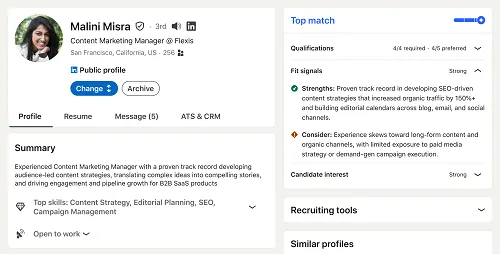
LinkedIn said its updated Hiring Assistant AI bot has improved reasoning, memory and personalization capacity, which will enable it to deliver better candidate recommendations.
That could result in more relevant matches for recruiters.
As explained by LinkedIn: “In the past, a recruiter would ask Hiring Assistant to find a candidate in product management, and it would do that. Now, with advances in memory, Hiring Assistant will not only find a product management candidate, but it will now find one close to the office, in the retail industry and with mid-level experience, because those are all the things you've hired for in the past.”
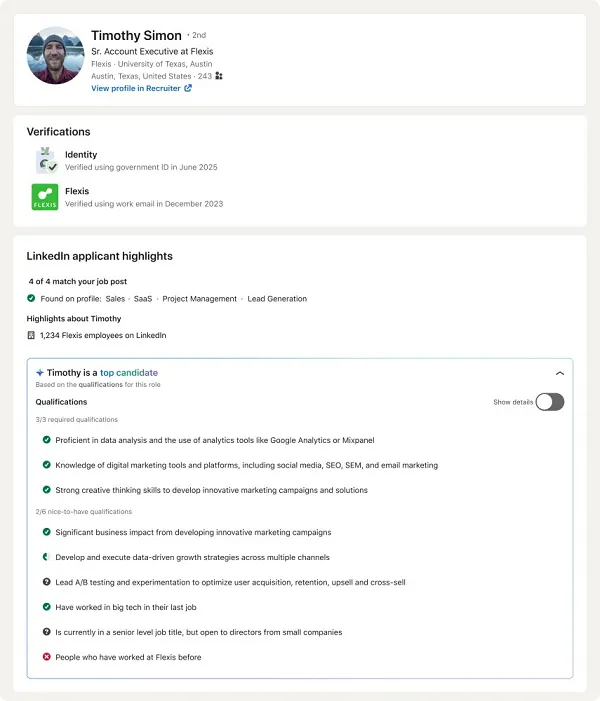
Hiring Assistant 2 will also show users more signals and indicators to demonstrate why they match. It will also offer indicators as to how receptive a candidate might be, based on signals including platform engagement, Open to Work details and InMail responsiveness.
LinkedIn is also integrating more trust signals, like verifications, to highlight legitimate prospects. It's also adding more connected apps listings, which provide a way for users to demonstrate their capabilities in external systems.
LinkedIn's also added more integrations to facilitate candidate management, along with voice capabilities in pre-screening.
LinkedIn said its AI recruitment assistant has driven positive results for many businesses already. More than 20,000 companies now use its agentic hiring solutions, and LinkedIn says that recruiters are four times more likely to contact candidates sourced by Hiring Assistant when compared to traditional recruiting methods.
These updates could drive that number even higher, with LinkedIn reporting that recruiters are already 27% more likely to contact a candidate sourced by Hiring Assistant compared to six months ago.
Based on its extensive pool of professional and career development insights gleaned from more than 1.3 billion members, LinkedIn’s candidate prediction models should be able to highlight more relevant candidates. To that end, these updates should help to increase the utility of its AI assistant.
Article top image credit: Retrieved from LinkedIn on October 01, 2026